


Table of Contents
- Why English Bridle Leather Collars Outlast the Rest
- What Makes English Bridle Leather Different from Other Leathers
- Full-Grain Leather Dog Collars: Strength, Shape and Shine
- Leather Collar Fit and Comfort for Working Dogs
- How to Measure a Dog for a Collar Before You Order
- How to Care for a Leather Dog Collar Through Break-In and Beyond
- Conclusion
- Frequently Asked Questions
Last Updated: October 9, 2026
Why English Bridle Leather Collars Outlast the Rest
The difference in how hide is tanned significantly impacts the lifespan of leather collars.
Bridle leather is a full-grain, vegetable-tanned leather hot-stuffed with natural oils, fats and waxes during production, packing the fibres with the conditioning agents you would otherwise apply by hand.
Below, we break down what separates bridle leather from the rest, how to size it correctly, and how to care for it.
What Makes English Bridle Leather Different from Other Leathers
English bridle leather is a full-grain leather tanned with vegetable extracts and then hot-stuffed with oils and waxes. It is denser, stiffer when new, and far more resistant to cracking than chrome-tanned or split-grain leathers. The name comes from its original use, bridles and reins for horses, and the same qualities make it ideal for a dog collar.

Vegetable Tanning and Natural Oils, Fats and Waxes
Vegetable tanning uses tree bark tannins instead of chromium salts. It takes longer and costs more, but the hide keeps its natural fibre structure intact.
During hot stuffing, the tanned hide is soaked in natural oils, fats and waxes while still warm, so the leather absorbs them deeply rather than sitting on the surface.
Cheaper collars skip this step and rely on a surface finish that wears off within months, leaving dry, cracked leather underneath.
How English Bridle Leather Compares with Other Collar Materials
Most collar buyers choose between four materials, not two. Here is how English bridle leather stacks up on the points that affect daily use.
Material |
Tanning / Make-Up |
Feel When New |
Care Needed |
Durability Pattern |
Best Suited To |
|---|---|---|---|---|---|
English bridle leather |
Full-grain, vegetable-tanned, hot-stuffed with oils and waxes |
Firm, slightly waxy |
Wipe dry, condition lightly a few times a year |
Softens and darkens with use; resists cracking for years |
Working dogs, daily wear, owners who want a collar that ages well |
Standard vegetable-tanned leather |
Full-grain, vegetable-tanned, not hot-stuffed |
Firm, drier |
Condition more often from the start |
Good, but dries out faster if neglected |
Budget-conscious buyers who will maintain it |
Chrome-tanned leather |
Tanned with chromium salts |
Softer, more uniform |
Minimal |
Can crack and flake where it flexes repeatedly |
Fashion collars, light use |
Biothane / coated webbing |
Synthetic core with a polymer coating |
Flexible, waterproof |
Rinse and wipe |
Does not absorb water or odour; can stiffen in cold |
Swimming, mud, wet climates |
Nylon webbing |
Woven synthetic |
Soft, lightweight |
Machine washable |
Abrades and fades; hardware usually fails first |
Puppies, temporary or backup collars |
- Biothane and nylon win on water. They are waterproof and rinse clean; bridle leather is water-resistant and needs drying time.
- Chrome-tanned leather wins on initial softness, but does not develop the same patina or hold shape as well under load.
- Bridle leather wins on longevity and appearance. A well-made collar can serve a dog for its whole adult life and look better at year five than at year one.
Why Full-Grain Matters More Than the Label
"Genuine leather" on a product page tells you almost nothing, it can describe bonded leather made from shredded scraps glued to a backing. Full-grain means the outermost layer of the hide, where the fibres are tightest and strongest, is left intact. Split leather has that top layer shaved away; bonded leather reassembles scraps. Both look acceptable in photographs and fail under load.
Full-Grain Leather Dog Collars: Strength, Shape and Shine
Full-grain leather dog collars keep the outermost layer of the hide, where the fibres are tightest and strongest. That layer gives bridle leather its wear resistance, shape retention and smooth, high-shine finish. Split and bonded leathers remove or destroy it, looking fine in photos and falling apart under load.
What you get with full-grain bridle leather:
- Strength under load: the tight fibre structure resists stretching, so the collar does not loosen over time
- Shape retention: the collar keeps its curve and width instead of sagging or curling at the edges
- A finish that improves: repeated handling brings up a soft sheen rather than rubbing it dull
That combination is why bridle leather remains the benchmark for working gear.
Leather Collar Fit and Comfort for Working Dogs
Leather collar fit and comfort decide whether a working dog can wear the collar all day without rubbing.
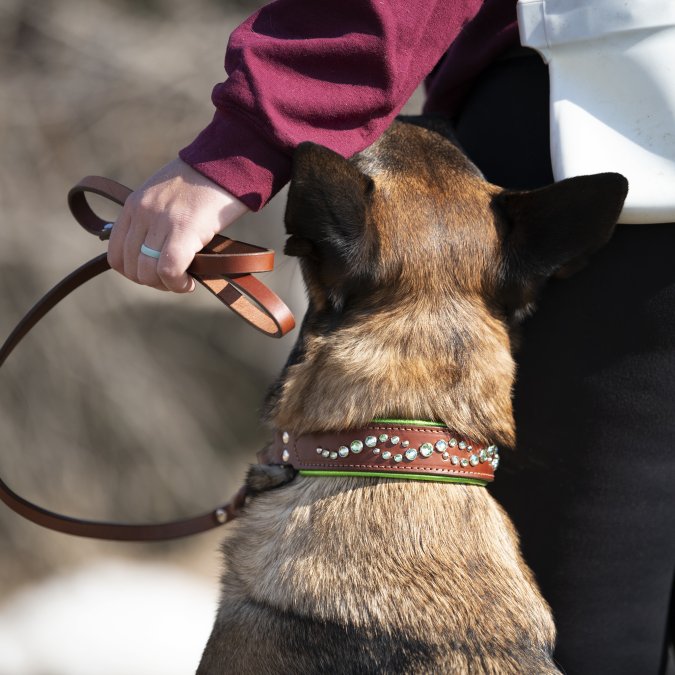
Best Leather Dog Collars for Training: 2026 Guide
A collar that sits too low chafes against the throat; one that is too tight restricts breathing and wears the coat.
Weight, Width and Coat Type by Dog Size
Match collar width to the dog's build and coat, not just its neck measurement.
Dog Size |
Suggested Width |
Why It Works |
Watch Out For |
|---|---|---|---|
Small (under 10 kg) |
3/4 - 1.25 inch |
Light enough to avoid neck strain |
Too-wide collars rub thin coats |
Medium (10-25 kg) |
1.5 inch |
Balanced pressure and comfort |
Check fit monthly during growth |
Large (25-45 kg) |
1.5 - 2 inch |
Spreads load on strong pullers |
Narrow collars dig into the neck |
Giant (45 kg+) |
1.75+ inches |
Maximum pressure distribution |
Weight of collar adds up |
Coat type matters too. Short, smooth coats show rub marks fast, so padded linings matter more. Thick double coats hide fit problems, so check under the collar weekly by feel.
How to Measure a Dog for a Collar Before You Order
To measure a dog for a collar, wrap a soft tape measure around the middle of the neck, snug but not tight, and add two fingers' width of slack.
Steps that avoid a bad fit:
The Mini Mardi Gras | Wide Custom Dog Collar →
- Use a soft cloth tape, not a metal one.
- Measure at the middle of the neck, not the base of the skull.
- Keep the tape level all the way round.
- Add 3/4 - 1 inch for comfort, depending on coat thickness.
- Measure twice, at different times of day.
- If your dog is between sizes, size up.
A common mistake is measuring an old collar instead of the dog: stretched leather gives a false reading.
If you are ordering a made-to-order collar, choose a collar size based on your dog’s neck measurement. At Fusion By Design Collars, every piece is made to order and backed by our right fit, right style guarantee, so a measuring error is fixable rather than final.
How to Care for a Leather Dog Collar Through Break-In and Beyond
Caring for a leather dog collar comes down to three habits: keep it dry, condition it lightly, and check the hardware. Bridle leather is stiff when new and softens over the first few weeks.
A Practical Break-In Guide
Break-in is simple: wear it and let the leather's natural oils do the work. Do not soak it, stretch it by hand, or oil it heavily in the first month, heavy oiling softens the fibres too fast and shortens the collar's life.
A realistic break-in timeline:
- Week 1: The collar feels firm and may sit slightly proud of the neck, with minor stiffness at the buckle fold. This is normal.
- Weeks 2 to 4: The leather begins to mould to the dog's neck shape, and the strap should curve rather than kink.
- Weeks 4 to 8: The collar is comfortable for full-day wear, and the surface develops a soft sheen.
If the collar still feels rigid after two months of daily wear, it is probably too dry. A light conditioning session will usually restore suppleness within a day or two.
How Often to Condition, and What to Use
Conditioning replaces the oils and waxes that wear out over time. The interval depends on climate and use:
- Temperate, dry climate: every three to six months
- Wet or humid climate: every two to three months, with extra drying time after each soak
- Working or training dog in daily use: every two to three months
A small amount of leather balm or neutral conditioner is all you need. Warm a pea-sized amount between your fingers and work it in with a soft cloth, paying attention to the buckle fold and strap edges where dryness shows first. Let it absorb for an hour, then buff off any excess.
What to avoid:
- Neatsfoot oil in large quantities. A little is fine; soaking the collar in it softens the fibres and causes stretching.
- Petroleum-based products. They can darken the leather unevenly and leave a greasy residue that attracts dirt.
- Saddle soap on a routine basis. It cleans well but strips oils, so use it only when the collar is genuinely dirty, then recondition.
Water, Weather and When to Replace a Collar
Bridle leather handles rain and snow far better than chrome-tanned leather, because the hot-stuffed oils push water away from the fibres. It is not waterproof, so a soaked collar should be dried slowly at room temperature, never on a radiator or in a tumble dryer. If your dog swims regularly, rinse the collar in fresh water afterwards, blot it, and hang it to dry away from direct heat, salt water and chlorinated pool water leave residue that dries the leather.
Replace a collar when you see any of these:
- Deep cracks that reach through the leather
- Stitching that has pulled loose at the buckle
- A buckle that no longer holds under load
Small surface scuffs are normal and can be buffed out. Cracks are not.
A Care Routine That Works
- Wipe mud off with a damp cloth and let the collar air dry away from direct heat
- Condition every three to six months with a small amount of leather balm
- Check stitching, rivets and the buckle every few weeks for looseness
Conclusion
Choosing a collar that survives serious training, weather and daily wear means choosing the right leather, the right fit and the right care routine.
Fusion By Design Collars handcrafts made-to-order leather dog collars in Canada from premium full-grain English Bridle leather, with genuine Swarovski™ crystals, padded linings and your choice of leather, crystal and hardware. Every piece is built on over 30 years of training and competing experience, with free worldwide shipping and a right fit, right style guarantee.
Frequently Asked Questions
Is English bridle leather good for dog collars?
Yes. English bridle leather is vegetable-tanned and hot-stuffed with natural oils, fats and waxes, which makes it strong, wear-resistant and slow to crack under repeated handling. It holds its shape rather than stretching, so the collar keeps its fit through daily walks and training. It starts stiff when new and softens with use, and a smooth finish wipes clean easily. For dogs in regular training, that combination of strength and comfort is hard to beat.
How do you care for an English bridle leather dog collar?
Wipe the collar with a damp cloth after muddy sessions, then let it dry away from direct heat. Apply a small amount of leather conditioner every few months, or more often if the leather looks dry. Keep it out of standing water and avoid harsh detergents, which strip the natural oils. Check the buckle and stitching each month. With basic conditioning, a bridle leather collar can stay supple and presentable for years of heavy use.
Can an English bridle leather collar get wet?
It can handle rain and a quick swim, but bridle leather is not waterproof. The oils and waxes packed into the hide resist light moisture, yet soaking the collar repeatedly will dry it out over time. If your dog swims often, rinse the collar in fresh water, dry it slowly at room temperature and condition it more frequently. Avoid drying it on a radiator, which hardens the leather and shortens its service life.
How should a dog collar fit?
You should be able to slide two fingers between the collar and your dog's neck. Any tighter and it will rub; any looser and your dog can slip out. Measure the neck at its widest point with a soft tape, then add 3/4 - 1 inch for comfort and choose a size from there. Recheck the fit monthly on puppies and after any weight change, and always confirm sizing before ordering a made-to-order collar.