


Table of Contents
- Why Leather Outperforms Synthetic Materials for Training
- Quick Comparison: Best Leather Dog Collars for Training
- 1. The Mia | Wide Custom Dog Collar: Best for Longer Necks and Large Dogs
- 2. The Future | Custom Dog Collar: Best for Medium to Large Breeds
- 3. The MoTH | Custom Dog Collar: Best for Style and Durability
- 4. The Wave | Custom Dog Collar: Best for Everyday Training
- 5. The Silas | Custom Dog Collar: Best for Sensitive Necks
- 6. The Devon | Traditional Padded Dog Collar: Best Value for Everyday Use
- How to Measure a Dog for a Training Collar
- Leather Collar Maintenance Tips
- Frequently Asked Questions
Last Updated: September 29, 2026
Why Leather Outperforms Synthetic Materials for Training
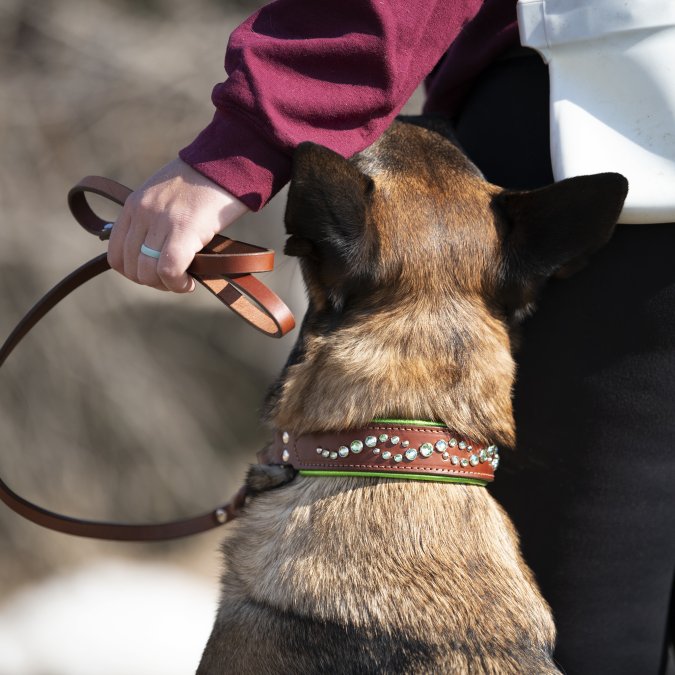
Leather dog collars have long been the choice of handlers who need gear that survives daily training. The best combine full-grain hides, solid hardware, and padded linings built to last years, not months.
Quick Comparison: Best Leather Dog Collars for Training
Collar |
Width |
Price (Canadian $) |
Best For |
|---|---|---|---|
2" |
From 350.00 |
Long Necks |
|
1.75" |
From 375.00 |
Medium to large breeds |
|
1.75" |
From 395.00 |
Style and durability |
|
1.5" |
From 315.00 |
Everyday training |
|
1.25" |
From 330.00 |
Sensitive necks and small dogs |
|
Various |
From 210.00 |
Everyday value |
1. The Mia | Wide Custom Dog Collar: Best for Longer Necks and Large Dogs
The Mia is the widest collar in this lineup at 2 inches, and that width is the point. A broader collar spreads pressure across a larger area of the neck, which matters for large dogs and sighthounds with long sensitive necks.

2. The Future | Custom Dog Collar: Best for Medium to Large Breeds
Not every dog needs a 2-inch collar, and not every dog fits well in a narrow one. The Future solves that gap at 1.75 inches, wider than a standard 1.5-inch collar but not as broad as The Mia.

3. The MoTH | Custom Dog Collar: Best for Style and Durability
The MoTH matches The Future at 1.75 inches but takes a different route on looks, built for owners who want a training collar that also reads as a statement piece.

4. The Wave | Custom Dog Collar: Best for Everyday Training
The Wave is a 1.25-inch padded leather collar for the dog that trains most days of the week. Narrower than the wide collars above, it suits dogs that don't need heavy pressure distribution but still need gear that lasts.
5. The Silas | Custom Dog Collar: Best for Sensitive Necks
The Silas is the collar for dogs that react badly to bulk. Its tapered buckle design reduces weight and mass where the collar fastens, which is often where irritation starts.
6. The Devon | Traditional Padded Dog Collar: Best Value for Everyday Use
The Devon is the collar for daily life at the lowest price in this group. Handcrafted by our artisans in our Ontario workshop, it uses full grain English Bridle leather in your choice of colour.
How to Measure a Dog for a Training Collar
Measuring for a training collar takes two minutes and prevents the most common fit problem: a collar that rubs or slips. But a single neck circumference is only half the story. The right collar for a Malinois in protection work is not the right collar for a Labrador on weekend walks, even if their necks measure the same. Width, leather weight, and hardware must match the dog's drive and body type.
The Basic Measurement
Use a soft tape measure around the middle of the neck, where the collar naturally sits, not at the base and not up behind the ears. Keep it snug but not tight, with room for two fingers under the tape. For a working dog, add a little room for muscle movement. If your dog falls between two sizes, size up and use the adjustment range.
Breed-Specific Sizing and Weight Requirements
Neck circumference tells you the size, not the width or leather weight the dog needs. That depends on the dog's build, drive, and how much pressure the collar will take.
Why Tensile Strength Matters More Than You Think
Leather's tensile strength depends on the hide, the tanning method, and the thickness of the cut. Full-grain English Bridle leather is dense and resists stretching because the fibres run tightly through the whole thickness of the hide. Split and bonded leather, common in cheaper collars, have shorter fibres and fail at lower loads.
The Mia | Wide Custom Dog Collar →
Fit Checks Before Every Training Block
- Two-finger rule: You should be able to slide two fingers under the collar at the neck's midpoint.
- Head-slip test: Gently try to pull the collar over the dog's head. If it comes off, it is too loose for training.
- Chafe check: After a session, look for red patches or rubbed fur. If you see them, the collar is too tight, too narrow, or the lining needs more padding.
- Hardware check: Tug the D-ring and buckle. Any movement that feels loose needs attention before the next session.
Every collar in this lineup is made to order, so an accurate measurement plus a realistic assessment of your dog's drive is what makes the right fit, right style guarantee work. When in doubt, send the maker your dog's breed, weight, neck measurement, and a short description of how the dog trains.
Leather Collar Maintenance Tips
Most buying guides stop at the checkout. That is a mistake, because a full-grain leather training collar is a long-term investment, and how you care for it in the first year determines whether it lasts three years or ten. Here is the routine we recommend to handlers who train several times a week.
A Monthly Conditioning Routine That Actually Works
Leather is skin. It holds natural oils that keep the fibres supple, and those oils migrate out through sweat, rain, mud, and UV exposure. When the oils go, the collagen fibres dry, stiffen, and eventually crack at the stress points, usually right where the D-ring sits, the worst possible place for a failure.
A simple routine prevents all of that:
- Wipe after every dirty session. A damp, not wet, cloth removes abrasive grit before it works into the grain and thins the leather at the buckle holes.
- Air dry away from heat. Never place a leather collar on a radiator, in a tumble dryer, or in direct sun. Heat drives out the oils faster than anything else. Room temperature and shade are enough.
- Condition every four to eight weeks. Frequency depends on use. Apply a small amount of a neutral leather conditioner, beeswax or lanolin-based balms work well, with a soft cloth, work it into the grain in small circles, and let it absorb for twenty minutes before buffing off the excess.
- Check the hardware at the same time. Solid brass and stainless steel do not rust, but rivets can loosen and buckles can bend. A loose rivet is a five-minute repair at a saddler and a snapped collar on a training field if ignored.
What to Do When Leather Dries Out or Cracks
If the leather feels stiff or shows fine surface cracks, it is not too late. Clean the collar with a dedicated leather cleaner, not saddle soap, which can leave residue, let it dry fully, then apply conditioner in thin layers over several days rather than one heavy coat. Thin layers penetrate; thick coats sit on the surface and attract dirt.
Simple Repairs You Can Do at Home
- Stretched buckle holes: A saddler can punch a new hole and burnish the edge. Do not punch your own hole without a proper punch and edge slicker, a ragged hole tears.
- Loose stitching: If a stitch line is fraying but the leather is sound, a saddler can restitch it. Do not glue it; glue fails under tension.
- Tarnished brass: A brass polish or a paste of lemon juice and bicarbonate of soda restores shine. Avoid abrasive pads, which scratch plated hardware.
- Faded dye: Some full-grain leathers lighten with sun exposure. This is patina, not damage, and most handlers consider it a feature.
Storage Between Sessions
Hang the collar on a hook rather than leaving it coiled in a bag; coiling creases the leather at the same point every time, and repeated creasing becomes a crack. Keep it out of direct sunlight and away from damp. In humid climates, a silica gel packet in the storage bag prevents mildew, which is far harder to remove than dirt.
Frequently Asked Questions
What collar do professional dog trainers recommend for training?
Trainers typically recommend leather collars for training because leather holds up to daily wear, resists stretching, and stays comfortable on the dog's neck. A padded leather collar with solid brass or stainless steel hardware and a secure buckle closure is a common choice. The collar should fit snugly without being tight, allowing two fingers to slide underneath. For working dogs, full-grain or English Bridle leather offers the abrasion resistance and tensile strength needed for rigorous sessions.
Are leather collars more durable than nylon for training?
Leather collars generally outlast nylon ones for training because leather develops a patina and grows supple with use rather than fraying. Full-grain and latigo leather resist stretching under tensile load, while nylon can weaken at the stitching points over time. Leather also handles abrasion from check cords and leash attachment better. With proper leather conditioning every few months, a quality leather collar can last for years of daily training.
How do I choose the right size leather collar for my dog?
Measure your dog's neck circumference at the widest point with a soft tape measure. For training collars, the fit should be snug enough that the collar does not slip over the head but loose enough to slide two fingers underneath. Breed-specific sizing matters: a Rottweiler may need a 2-inch wide collar for pressure distribution, while a Jack Russell Terrier needs a narrower 1.25-inch option. Always check the maker's sizing chart before ordering.
How do you maintain a leather dog collar for long-term use?
Wipe the collar with a damp cloth after muddy sessions, then let it air dry away from direct heat. Apply a leather conditioner every two to three months to keep the leather supple and prevent cracking. Avoid soaking the collar in water or using harsh soaps, which strip natural oils. Check the hardware and stitching regularly for wear. If the collar gets wet, dry it naturally; never use a hairdryer, as heat damages the leather fibres.
Is full-grain leather better for heavy-duty training?
Full-grain leather is the strongest part of the hide because it retains the dense fibre structure, making it ideal for heavy-duty training. It resists abrasion, holds up to tensile load, and develops a rich patina over time. Latigo leather, which is vegetable-tanned and oiled, is another excellent choice for working dogs because it stays supple in wet conditions. Both outperform split leather or bonded leather, which delaminate under stress.