


Table of Contents
- How to Measure Your Dog’s Neck for a Collar: Step-by-Step
- Tools You Need for Accurate Neck Measurement
- The Two-Finger Rule and Snug Fit Explained
- Understanding a Dog Collar Size Chart
- Dog Collar Fit Guide: Buckle vs. Martingale Leash
- Dog Collar Width Guide: Matching Width to Breed
- Common Measuring Mistakes and Visual Troubleshooting
- Conclusion
- Frequently Asked Questions
Last Updated: September 29, 2026
How to Measure Your Dog’s Neck for a Collar: Step-by-Step
A well-fitted collar keeps your dog safe and comfortable. At Fusion By Design Collars, we've sold over 6,000 handmade leather collars since 2016, and the top buyer question is: how do I get the size right? Learning how to measure your dog’s neck for collar sizing takes two minutes and prevents slipping, rubbing, and mid-walk escapes.
The short version: wrap a soft tape around the base of the neck, keep it snug, and add room for two fingers.
The details matter most for sighthounds, puppies, and thick-coated dogs.
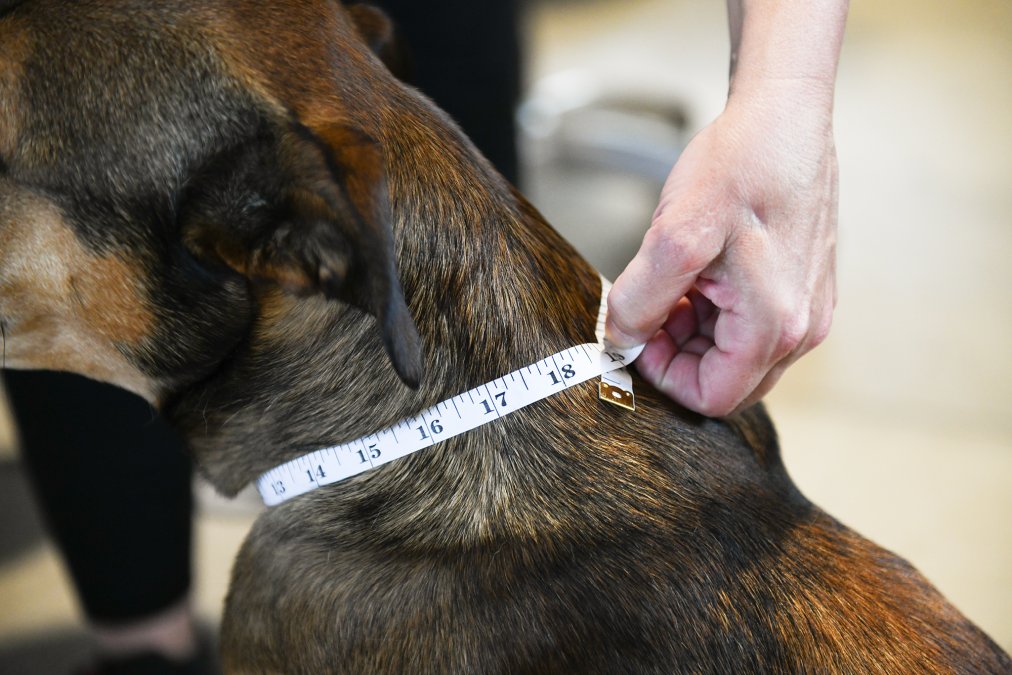
Close-up of a person's hands gently wrapping a soft measuring tape around a calm dog's neck at the base, dog relaxed, natural indoor lighting
Follow these steps in order:
- Gather your tools. A soft measuring tape, or string plus a ruler.
- Calm your dog. Use a treat; measure when relaxed, not mid-play.
- Find the base of the neck. Where the neck meets the shoulders, not near the ears.
- Wrap the tape around. Keep it level, where the collar normally rests.
- Check the snug fit. The tape should touch the fur without pressing into skin.
- Add the two-finger allowance. Slide two fingers under the tape; that gap is your collar size.
- Write it down. Record in inches with the date. Puppies change fast.
- Repeat twice. Average three measurements for accuracy.
Tools You Need for Accurate Neck Measurement
A soft measuring tape is the gold standard, but string or a phone charging cable plus a ruler works too. The key is flexibility: a stiff ruler won't curve around the neck and gives a straight-line reading that's too short.
Here's what to have on hand:
- Soft measuring tape (tailor's or sewing tape)
- String or cord if you don't own a tape
- A ruler for measuring the string
- Treats to keep your dog still
- A helper for wiggly dogs
- A notebook or phone to record the number
For the string method, wrap it around the neck, mark the overlap, then lay it flat against a ruler to get your neck circumference.
Avoid metal tape measures: they don't bend smoothly and the hook catches fur.
The Two-Finger Rule and Snug Fit Explained
The two-finger rule is the fastest tension check. Slide two fingers between collar and neck: comfortable fit means correct, four fingers means too loose, fewer than two means too tight.
A loose collar slips over the head; a tight one rubs, restricts breathing, and irritates sensitive skin.
Snug fit means close to the neck without pinching, it shouldn't spin freely or leave marks.
Check three spots, under the chin, behind the ears, and at the base of the neck. Passing the two-finger test in all three means a proper fit.
Understanding a Dog Collar Size Chart
A dog collar size chart translates your measurement into a size. Most charts list neck circumference ranges, not collar length, the collar is longer than the neck because it overlaps at the buckle.
Here's how a typical sizing guide breaks down:
|
Size |
Neck Circumference |
Typical Dog Weight Range |
Best For |
|---|---|---|---|
|
XS |
20-25 cm |
2-5 kg |
Toy breeds, puppies |
|
S |
25-30 cm |
5-10 kg |
Small breeds |
|
M |
30-40 cm |
10-20 kg |
Medium breeds |
|
L |
40-50 cm |
20-35 kg |
Large breeds |
|
XL |
50-60 cm |
35-50 kg |
Giant breeds |
Always measure before ordering. Breed labels are rough guides: two Labradors of the same weight can wear different sizes.
Dog Collar Fit Guide: Buckle vs. Martingale Leash
Buckle collars and martingale leashes fit differently. A buckle collar uses a standard buckle and adjustment holes, sits at a fixed size, and relies on the two-finger rule.
Sizing rules differ:
- Buckle collar: Measure the neck, add two fingers of space.
- Martingale leash (leash/collar combo): Measure the widest part of the head, then the neck; it must slip over the head but tighten safely on the neck.
- Choke chain or slip chain: Not recommended for daily wear; tension-based designs can cause injury.
Dog Collar Width Guide: Matching Width to Breed
How width interacts with neck anatomy:
- Sighthounds (Greyhounds, Whippets, Salukis, Borzois): These breeds have a long, slender neck with very little fat and a prominent trachea. A wide collar (5.0 cm / 2.0 in or more) can press on the trachea when the dog lowers its head to sniff or drink. A 3.8 cm (1.5 in) to 5.0 cm (2.0 in) martingale leash is usually the better match, because the tightening loop distributes pressure around the neck rather than across the front.
- Brachycephalic breeds (Bulldogs, Pugs, Boston Terriers, French Bulldogs): These dogs have short, thick necks and often narrow tracheas. A wide collar can sit too high and rub the throat. A 2 cm (3/4 in) to 3 cm (1.25 in) collar that sits low on the neck, below the throat, is typically more comfortable. Measure carefully: the neck is often wider than it looks because of the loose skin and folds.
- Thick-coated breeds (Huskies, Samoyeds, Malamutes, Chow Chows): The coat adds apparent circumference. A collar that looks correctly sized on top of the fur can be too loose against the skin. Part the coat and measure against the skin, then add the two-finger allowance. A 3 cm (1.25 in) to 3.8 cm (1.5 in) width works well because it stays visible in the coat and does not disappear into the fur.
- Giant breeds (Great Danes, Mastiffs, Newfoundlands): These dogs have heavy necks and strong pull potential. A 3.8 cm (1.5 in) to 5 cm (2 in) collar spreads load and resists stretching. But width alone is not enough: the hardware and material must also match the dog's strength.
- Toy breeds and puppies: A 2 cm (3/4 in) collar is usually right. Anything wider can rub the windpipe on a small neck. Puppies need a collar that is light enough not to weigh them down and adjustable enough to grow with them.
A quick width check: With the collar on, watch your dog walk, turn, and lower its head. Pressing on the throat means too wide or too high; sliding to the shoulders means too loose; a dent in the fur means too tight. Adjust until all three checks pass.
Common Measuring Mistakes and Visual Troubleshooting
Most sizing problems come from a handful of repeat mistakes. Each one below pairs the error with a visual check you can run in seconds.
Visual Troubleshooting: Too Tight vs. Too Loose
Run this checklist at rest and again after a short walk.
Too tight:
- You cannot fit two fingers under the collar.
- The collar leaves a dent or groove in the fur.
- Skin is red, irritated, or losing hair.
- Your dog coughs or pulls away when you touch the collar.
- It sits high near the throat instead of closer to the base.
Too loose:
- Four or more fingers fit under the collar.
- It slides up behind the ears when your dog lowers its head.
- Your dog can pull it over its ears or back out.
- It spins freely around the neck.
- It catches on furniture, branches, or crate bars.
Just right:
- Two fingers fit comfortably under the collar.
- It stays close to the base of the neck during walks, turns, and head lowering.
- No fur dent, redness, or rubbing.
- Your dog ignores the collar and moves normally.
Conclusion
Getting the size right takes two minutes and saves months of discomfort. Measure where the collar will naturally sit close to the base of the neck, keep the tape snug, leave room for two fingers, then match collar style and width to your dog's breed and build.
Frequently Asked Questions
What size neck does a 30 lb dog have?
A 30 lb dog's neck size varies by breed. For example, a Cocker Spaniel might have a 14-16 inch neck, while a French Bulldog could be 12-14 inches. Always measure your individual dog for accuracy. Use a soft measuring tape at the base of the neck, then add 2 inches for comfort. Check our dog collar size chart for general ranges.
How do I measure for a custom leather dog collar?
To measure for a custom leather dog collar, use a soft measuring tape or string around the base of the neck. Keep it snug but not tight. Record the measurement in inches. For custom collars, provide the exact neck measurement, not the collar length. Fusion By Design Collars recommends measuring twice for accuracy and offers a right fit, right style guarantee.
How much space should be between a dog's collar and neck?
You should be able to fit two fingers between the collar and your dog's neck. This ensures a snug fit without choking. For martingale leashes, the fit is slightly tighter when pulled but should still allow two fingers when relaxed. Always check for proper fit regularly, especially with puppies.
Does a dog's breed affect collar sizing?
Yes, breed affects collar sizing due to neck anatomy. Breeds with thick necks (e.g., Bulldogs) need wider collars and larger sizes, while slender breeds (e.g., Greyhounds) need smaller sizes. Always measure your specific dog. Our dog collar width guide helps match width to breed for comfort and safety.