


Table of Contents
- Full Grain Leather vs Bonded Leather: The Honest Comparison
- What Full Grain Leather Actually Is
- What Bonded Leather Actually Is
- Durability of English Bridle Leather: How Full Grain Holds Up
- How to Identify High-Quality Leather Dog Collars
- Cost Per Use: Why Bonded Leather Costs More Than You Think
- Leather Dog Collar Maintenance Tips for Long-Term Wear
- Repairability and Sustainability: Two Things Bonded Leather Cannot Offer
- Frequently Asked Questions
Last Updated: September 29, 2026
Full Grain Leather vs Bonded Leather: The Honest Comparison
Walk into any pet shop and you will find two collars side by side, both labelled "leather", with wildly different price tags. One is full grain leather, cut from the top layer of an animal hide. The other is bonded leather, a man-made sheet built from leather scraps and a synthetic binder. Understanding the difference between full grain leather vs bonded leather is the single most useful thing you can do before buying gear for a dog that trains, travels and works.
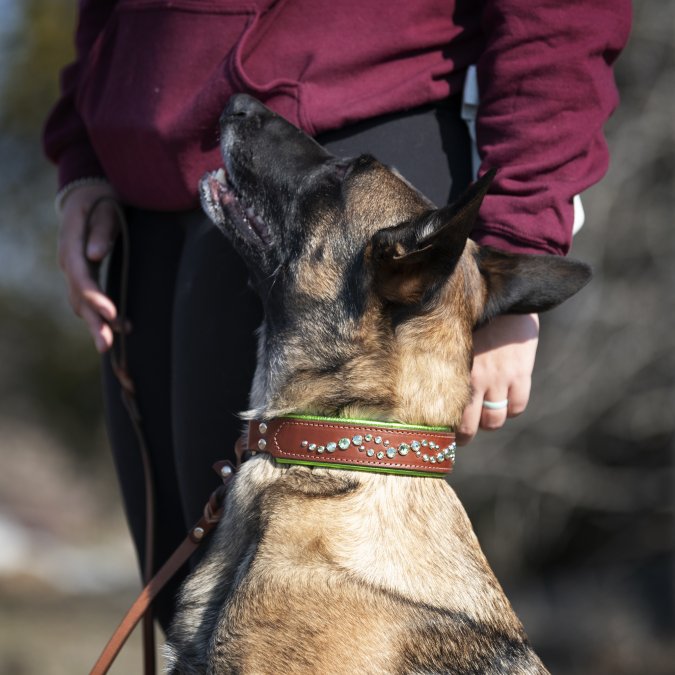
Best Leather Dog Collars for Training: 2026 Guide
What Full Grain Leather Actually Is
Full grain leather is the outermost layer of an animal hide, with the natural grain left intact and no surface sanding or correction.
What Bonded Leather Actually Is
Bonded leather is a reconstituted material made by shredding leather scraps and fibres, mixing them with a synthetic binder, and pressing the mixture onto a backing sheet. Manufacturers then roll a polyurethane or vinyl coating across the surface and emboss a grain pattern into it. The result looks like leather in a photograph. In the hand, it feels uniform and slightly plasticky, because the surface you touch is coating, not hide.
How Bonded Leather Is Made, Step by Step
- Collection. Offcuts, shavings and trimmings from other leather production are gathered, pieces too small or irregular to be used as a solid hide.
- Shredding. The scraps are ground into short fibres, often no longer than a few millimetres, destroying any continuous fibre structure the hide once had.
- Binding. The fibres are mixed with a synthetic binder, typically latex, polyurethane or resin, until they form a paste.
- Pressing onto a backing. The paste is rolled or pressed onto a fabric or paper backing sheet for dimensional stability.
- Coating. A polyurethane or vinyl layer is applied to the top surface. This coating, not the leather fibre, is what you see and touch.
- Embossing. A heated plate presses a grain pattern into the coating so the sheet resembles a real hide.
The leather content is often a minority of the finished sheet's weight; the structural integrity comes from the binder and coating, not the hide. That is why bonded leather is sometimes described as 'leather dust held together with glue', blunt, but fair.
Why Bonded Leather Peels
Peeling is not a defect from a bad batch. It is the predictable end state of the manufacturing method.
The 'Genuine Leather' Trap
A common mistake is assuming the 'genuine leather' stamp means quality. In practice, the term is unregulated in most markets and applied to almost any material containing some leather content, including bonded sheets and low-grade split leather. If a product is described only as 'genuine leather' with no further detail, treat it as a prompt to inspect the edge and grain yourself rather than a quality guarantee.
Durability of English Bridle Leather: How Full Grain Holds Up
English Bridle leather is a full grain, vegetable-tanned leather finished for high tensile strength, which is why it holds up to pulling, moisture and daily abrasion far better than bonded material.
Feature |
Full Grain Leather |
Bonded Leather |
|---|---|---|
Source |
Top layer of animal hide |
Leather scraps plus binder |
Grain |
Natural grain, intact |
Embossed pattern on coating |
Fibre structure |
Long, interlocking fibres |
Short, chopped fibres |
Wear pattern |
Patina, softens with age |
Peeling, cracking, delamination |
Repairable |
Yes, edges and holes can be refinished |
Rarely, coating fails first |
Best for |
Training, travel, daily wear |
Light, occasional use |
How to Identify High-Quality Leather Dog Collars
High-quality leather dog collars show an irregular natural grain, a raw cut edge, and a supple feel that responds to pressure rather than bouncing back like plastic. Run this checklist in a shop or when a parcel arrives:
- Look at the edge: full grain shows a solid, fibrous cross-section, not a layered sandwich
- Check the grain: natural markings, pores and slight variation are good signs
- Press a thumbnail in: full grain creases and slowly recovers, bonded stays rigid
- Smell it: leather smells like leather, bonded smells like adhesive or plastic
- Bend it: bonded leather creases into a sharp white line where the coating splits
- Check the stitching: tight, even stitching into solid material holds, loose stitching into coating pulls out
Tactile and Sensory Testing at Home
Sensory testing is the fastest way to separate the two materials without tools. Warm the collar in your hands: full grain warms and softens against your palm, while bonded leather stays cool and slick because the polyurethane coating blocks body heat. Run a fingertip along the surface: natural grain has tiny irregularities and pores you can feel, while an embossed pattern repeats identically.
Cost Per Use: Why Bonded Leather Costs More Than You Think
Most comparisons stop at the checkout price. The number that matters is cost per use, the purchase price divided by the number of days the item actually serves before it fails.
Traditional Leather Dog Leash →
The Cost-Per-Use Formula
Cost per use = purchase price ÷ (months of service × days worn per month)
Scenario |
Purchase price |
Service life |
Days worn per month |
Cost per use |
|---|---|---|---|---|
Bonded collar, replaced each time it peels |
Low |
6-12 months |
30 |
Higher |
Bonded collar, replaced three times over three years |
Low × 3 |
36 months total |
30 |
Highest |
Full grain collar, bought once |
Higher |
5-10+ years |
30 |
Lowest |
The Hidden Costs of Replacement
Purchase price is only part of the bill. Every replacement carries hidden costs:
- Timing. Bonded collars tend to fail mid-season, often just before a competition, a trip or a training block. You buy the replacement in a hurry, at whatever price is available.
- Fit. A replacement collar is a new collar. It has to be re-fitted, re-broken-in and re-checked for rubbing.
- Waste. Each failed collar is discarded. Over a decade, that is a stack of unrecyclable material.
- Attention. A collar you have to monitor for peeling is a collar you cannot fully trust under load.
Why Full Grain Wins the Long Game
Full grain leather has no coating to fail, so its service life is limited mainly by care and the physical wear of the fibres themselves. Conditioned a few times a year and kept dry, it can serve for many years and be repaired rather than replaced when a buckle or hole finally gives out.
A Simple Way to Decide
If you want the lowest outlay today and the collar will see light, occasional use, bonded leather will do for a while. If it will be worn daily, pulled on, rained on and used for training or travel, work out the cost per use over three years first. In most cases the full grain option is the cheaper collar, even though it is the more expensive purchase.
Leather Dog Collar Maintenance Tips for Long-Term Wear
Leather dog collar maintenance comes down to three habits: keep it dry, clean it gently, and condition it before the leather dries out.
- Wipe the collar with a damp cloth after muddy walks, then let it air dry away from direct heat
- Clean with a mild saddle soap every few months, working a small amount into the grain
- Condition with a leather conditioner a few times a year, more often in dry climates
- Check the buckle holes and D-ring monthly for stretching or cracking
- Rotate between two collars if your dog swims often, so each one dries fully
- Store collars flat or hanging, never crumpled in a damp bag
Repairability and Sustainability: Two Things Bonded Leather Cannot Offer
Repairability is where full grain leather separates itself permanently from bonded material. A leather worker can re-punch stretched holes, refinish worn edges, replace a buckle and re-stitch a full grain collar, extending its working life by years. Bonded leather cannot be repaired once the coating delaminates, because there is no continuous fibre to stitch into.
Frequently Asked Questions
What are the disadvantages of full grain leather?
Full grain leather keeps the hide's natural surface, so visible scars, insect marks and uneven colouring are normal. It also costs more upfront and needs occasional conditioning to stay supple. For a working dog, those trade-offs buy you fibre density that resists cracking and peeling for years, which bonded leather cannot match because its surface is a polyurethane coating over reconstituted leather scraps.
Is bonded leather as good as real leather?
No. Bonded leather is reconstituted leather: scraps and fibres are mixed with a synthetic binder, then covered with a thin polyurethane coating. It has no continuous hide integrity, so the coating is usually the first thing to fail. Delamination, peeling and cracking appear at flex points like the buckle and D-ring far sooner than on full grain leather.
How can you tell the difference between real and bonded leather?
Look at the cut edge. Full grain leather shows a solid, fibrous cross-section from top layer to underside. Bonded leather shows a layered sandwich: a thin surface film over a grey or brown composite core. Press a fingernail into the surface; full grain creases and springs back with natural grain, while bonded leather feels uniform and plastic-like and may hold the dent.
Why is full grain leather the best choice for dog collars?
Dog collars take constant abrasion from leash hardware, rolling, swimming and pulling. Full grain leather has intact fibre structure and higher tensile strength, so it absorbs that punishment instead of splitting. A collar made from English Bridle leather, such as our Sirius or Loch designs, also develops a patina over time, meaning it looks better as it ages rather than deteriorating.
Choosing dog gear means weighing a low price today against years of reliable service, and bonded leather rarely wins that trade once you count replacements. Fusion By Design Collars makes made-to-order collars and leashes from full grain English Bridle leather, with Swarovski crystal options, custom sizing and free worldwide shipping. Choose your design and get a collar built to last through training, travel and everything after.