


Table of Contents
- The Two Finger Gap: What It Gets Right and Where It Fails
- How to Measure Your Dog's Neck for a Collar
- Signs a Dog Collar Is Too Tight (and What It Does to the Trachea)
- Signs a Dog Collar Is Too Loose: Escape Risk and Snag Hazards
- Choosing the Right Collar Size for Puppies: Growth Tracking That Works
- Coat Type and Activity: The Fit Adjustments Most Guides Miss
- Full Grain Leather Dog Collar Benefits for Fit and Comfort
- Conclusion
- Frequently Asked Questions
Last Updated: September 30, 2026
The Two Finger Gap: What It Gets Right and Where It Fails
Ask ten dog owners how to check a collar and most will say the same thing: slip two fingers under the strap. The two finger gap test is the most repeated piece of collar advice in the world, a decent starting point, but not a complete answer.
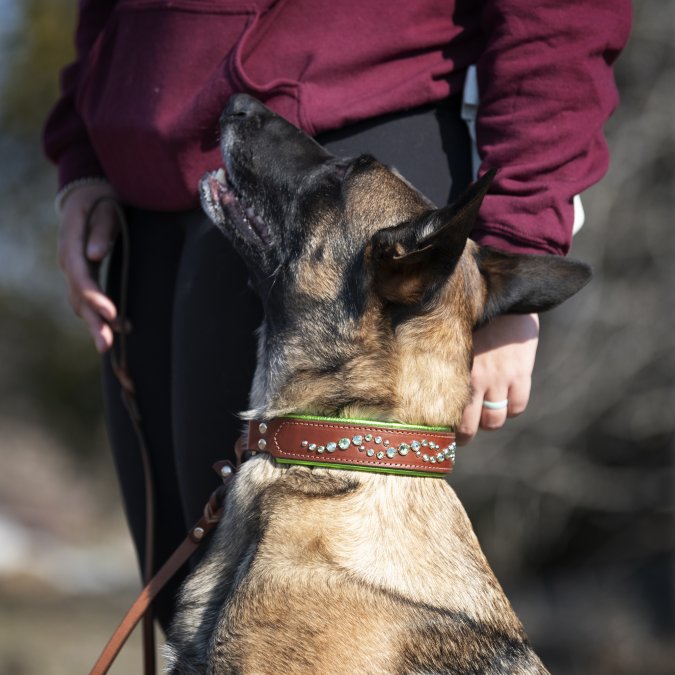
Best Leather Dog Collars for Training: 2026 Guide
Where the Rule Comes From
The two-finger rule comes from working dog and kennel traditions, where handlers needed a fast, no-tools way to check dozens of dogs at once. Veterinary and welfare guidance still treats it as a reasonable field test, but people treat "two fingers fit" as proof the collar is correct and stop thinking about it.
Three Cases Where Two Fingers Mislead You
1. The thick-coated dog. On a Husky, Malamute or Newfoundland, your fingers press into fur, not strap tension, so you feel space when the collar is actually snug against the skin.
How to Measure Your Dog's Neck for a Collar
Measuring a dog's neck takes about a minute and gives you a real number instead of a guess. You need a soft measuring tape and a calm dog.
- Stand or kneel beside your dog, not in front, facing a dog head-on invites wriggling.
- Wrap the tape around the middle of the neck, between the ears and the shoulders, where the collar should sit.
- Keep the tape snug against the coat but not tight; you should slide one finger under it, no more.
- Write down the number in centimetres and add a small allowance for comfort, a collar should sit close to the measured size, not several centimetres larger.
- Measure again a week later if your dog is still growing.
Measuring a Puppy vs an Adult Dog
An adult dog's neck size barely changes, so measure once and check the fit every few weeks. A puppy is a moving target: measure every two to three weeks until growth slows. A lightweight, narrow collar suits a puppy better than a heavy one; save the wide, padded collar until your dog has finished growing.
Signs a Dog Collar Is Too Tight (and What It Does to the Trachea)
A collar that is too tight presses on the trachea, the windpipe that carries air to the lungs. The neck also carries nerves, blood vessels and the thyroid gland, and constant pressure causes real harm over time.
Watch for these signs:
- A visible groove in the coat or a mark on the skin
- Coughing, wheezing or honking when the lead tightens
- Fur rubbed thin or matted under the strap
- Scratching at the collar or pulling away when you reach for it
- Redness, bald patches or skin irritation
- Bloodshot eyes after a walk
Signs a Dog Collar Is Too Loose: Escape Risk and Snag Hazards
A loose collar fails in two ways: your dog can slip out of it, or it can catch on something and trap your dog. Both are serious and easy to miss, because a loose collar looks comfortable.

The Devon | Traditional Padded Dog Collar
Check for these warning signs:
- The collar slides toward the shoulders when your dog lowers its head
- Two fingers slide under with room to spare, or your whole hand fits
- The buckle or D-ring hangs low on the chest
- The collar twists around the neck during play
- Your dog has backed out of it once, even briefly
- You can rotate the collar without it catching on the fur
How Dogs Actually Slip a Collar
Escape is a mechanical problem, not a behavioural one. A dog backs out when three things line up: the strap sits low on the neck, the gap is wider than the widest part of the head, and the dog pulls backwards against a fixed lead.
Snag Scenarios to Watch For
A loose collar catches on more than owners expect. The most common snag points are:
- Crate bars, a low-hanging collar can hook on a bar as the dog turns
- Fence posts and wire, the D-ring or buckle catches as the dog pushes through a gap
- Branches and shrubs, a low-hanging collar snags on the way past
- Furniture and door handles, a risk indoors, especially for dogs that jump
- Another dog's collar or jaw, two loose collars can interlock during rough play
Distinguishing 'Slightly Loose' from 'Dangerously Loose'
Not every loose collar is a problem, one that sits a little low on a broad-chested dog with a thick coat may be safe. The distinction comes down to three questions:
- Can the collar pass over the widest part of the head? If yes, it is too loose, regardless of how it looks.
- Does it stay in place when your dog shakes? If the collar ends up around the shoulders, it is too loose.
- Has the dog ever backed out of it? One escape is enough, treat it as a permanent risk.
Choosing the Right Collar Size for Puppies: Growth Tracking That Works
Choosing a collar size for a puppy is a moving job, not a one-time decision. Puppies grow in bursts, and a collar that fits at eight weeks will not fit at sixteen.
A simple tracking system works better than guesswork:
The Breckenridge | Wide Custom Dog →
Check |
How Often |
What to Do |
|---|---|---|
Neck measurement |
Every 2-3 weeks |
Record the number in centimetres or inches |
Finger test |
Every few days |
One finger for wide collars, two for narrow |
Coat and skin check |
Weekly |
Look for rub marks or matting |
Hardware check |
Weekly |
Confirm buckle and D-ring sit firm |
Coat Type and Activity: The Fit Adjustments Most Guides Miss
Coat type changes how a collar sits, and most fitting guides skip it entirely. The two-finger test assumes you are feeling strap tension against skin; on most dogs you are feeling fur. That is why the rule fails so often, and why coat-specific adjustment matters more than the finger count.
Double-Coated Breeds
Double-coated dogs carry a dense, woolly undercoat plus a longer, weather-resistant topcoat, the Husky, Malamute, Samoyed, Newfoundland, Akita, Chow Chow and most Spitz types.
Smooth-Coated Breeds
Smooth coats, Boxers, Dobermans, Greyhounds, Whippets, Beagles, most pointers, show every mark. With no fur to cushion the strap, a slightly tight collar leaves a visible groove within an hour and a slightly loose one slides freely.
Curly and Woolly Coats
Poodles, Bichons, Lagottos, Portuguese Water Dogs and doodle crosses have coats that mat easily. A narrow strap digs into the curl and creates a mat line underneath, painful to brush out and able to hide skin problems.
Hairless and Very Short-Coated Breeds
Hairless breeds, Chinese Crested, Xoloitzcuintli, American Hairless Terrier, and dogs clipped to the skin have no buffer at all. The strap sits directly on skin that is often sensitive and prone to irritation.
Long-Coated Breeds
Long coats, Afghan Hounds, Old English Sheepdogs, Collies, Yorkshire Terriers in full coat, hide problems, and a collar can be too tight for weeks before anything shows on the surface.
Matching Fit to Activity
Coat type sets the baseline; activity sets the tolerance.
- Daily walking: Comfort is the priority. A collar that sits high and snug, with the coat-specific adjustment above, suits most dogs.
- Training and obedience work: The collar must stay in place under sharp direction changes. A slightly higher, snugger fit is safer than a loose one, because a collar that shifts during an exercise is both ineffective and a choking risk.
- Agility, sprinting and bite work: These dogs need a collar that does not move at all under load. Many handlers use a snug, wide collar for the working session and remove it immediately afterwards.
- 24/7 wear: A collar worn at home, in a crate or overnight is a snag risk every hour it is on. If your dog wears one around the clock, check the fit more often, not less, and for many dogs, removing the collar indoors is the safer choice.
Visual Troubleshooting: Reading the Fit on Your Dog
Look at your dog from the side and from the front. A well-fitted collar sits high on the neck, just behind the ears, and stays there when your dog moves.
- Collar sits low on the shoulders: too loose, tighten it
- Collar rides up toward the ears: too tight, or the strap is too narrow
- Visible groove in the coat: too tight
- Collar twists sideways during play: wrong width for the neck shape
- Fur matted under the strap: too narrow or too tight
- Redness or bald patch: too tight, resize now
- Collar invisible in the coat: check against the skin, not the surface
Full Grain Leather Dog Collar Benefits for Fit and Comfort
Full grain leather is the top layer of the hide, and it keeps the tight fibre structure that gives leather its strength; lower grades are sanded down, which removes that structure and shortens the collar's life.
Conclusion
Getting the fit right takes more than a quick finger check. Measure the neck, watch how the collar sits during real activity, and recheck after every bath, clip and growth spurt. Your dog's comfort and safety depend on it.
Frequently Asked Questions
How tight should a dog collar be?
A collar should sit snug enough that it cannot slip over your dog's head, but loose enough that you can slide two fingers flat between the collar and the neck without forcing them. That two finger gap is a starting point, not a fixed rule. For dogs with thick double coats, the collar should sit just above the fur layer, so the gap may look smaller than it does on a smooth-coated dog.
Does the two finger rule apply to all dog breeds?
No. Neck shape and coat thickness change how the rule works in practice. Sighthounds and other slender-necked breeds often need a collar that sits higher on the neck to prevent slipping, while thick-coated breeds such as huskies need the collar checked under the fur, not on top of it. Puppies also outgrow the rule within weeks, so the gap needs rechecking more often.
How often should I check my dog's collar fit?
Check the fit once a week as a minimum, and after any grooming session, since trimming a thick coat can change how the collar sits. Puppies need a check every few days during rapid growth phases. Also check before and after intense activity such as training, swimming or hiking, because wet leather can stretch and a loosened collar is an escape risk.
Can a dog collar be too loose?
Yes, and it is a common problem. A collar that slides down the neck can be backed out of during a startle response, and a loose collar can catch on fence posts, crate bars or branches. If you can pull the collar over your dog's head without unfastening it, it is too loose. A properly fitted collar stays in place when your dog shakes, turns and pulls.