


Table of Contents
- What Size Collar Does a 20lb Dog Need?
- Dog Collar Size Chart by Weight
- How to Measure a Dog's Neck for a Collar
- How Tight Should a Dog Collar Be?
- Leather Dog Collar Sizing: What Makes It Different
- Choosing Between Sizes and Avoiding Common Mistakes
- Frequently Asked Questions
Last Updated: October 5, 2026
What Size Collar Does a 20lb Dog Need?
Wondering what size collar for a 20lb dog?
The short answer: measure the neck, add room for two fingers, then match that number to the maker's size chart. Weight is only a rough filter for where to start.
According to the American Kennel Club's guidance on collar fitting, a collar should sit snug enough that it cannot slip over the dog's head, yet loose enough to slide two fingers underneath.
Below, we show you how to measure your dog's neck, how tight the collar should sit, and how leather sizing differs from nylon.
Dog Collar Size Chart by Weight
Weight charts are a starting point, not a verdict. Find your dog's likely size band below, then confirm with a tape measure.
Weight |
Typical Neck Range |
Common Size |
Example Breeds |
|---|---|---|---|
5-10 lb |
8-10 in (20-25 cm) |
XS |
Chihuahua, Yorkie |
10-20 lb |
10-13 in (25-33 cm) |
S |
Pug, Shih Tzu |
20-30 lb |
12-15 in (30-38 cm) |
S-M |
Cocker Spaniel, Beagle |
30-50 lb |
14-18 in (36-46 cm) |
M |
Border Collie, Boxer |
50-80 lb |
18-24 in (46-61 cm) |
L |
Labrador, German Shepherd |
A 20lb dog sits on the border between small and small-medium, which is exactly why measuring matters more than the number on the scale.
How to Use a Weight-Based Chart Correctly
Treat the chart as a first guess, then verify:
- Find your dog's weight band, then note the neck range beside it
- Measure the actual neck before ordering
- Check the maker's own size chart, because ranges differ between brands
Body shape throws charts off: a deep-chested dog with a thick coat measures larger than its weight suggests, while a slender sighthound measures smaller.
How to Measure a Dog's Neck for a Collar
Measuring takes about two minutes. Use a soft tape, keep it level, and read the number where the tape overlaps.
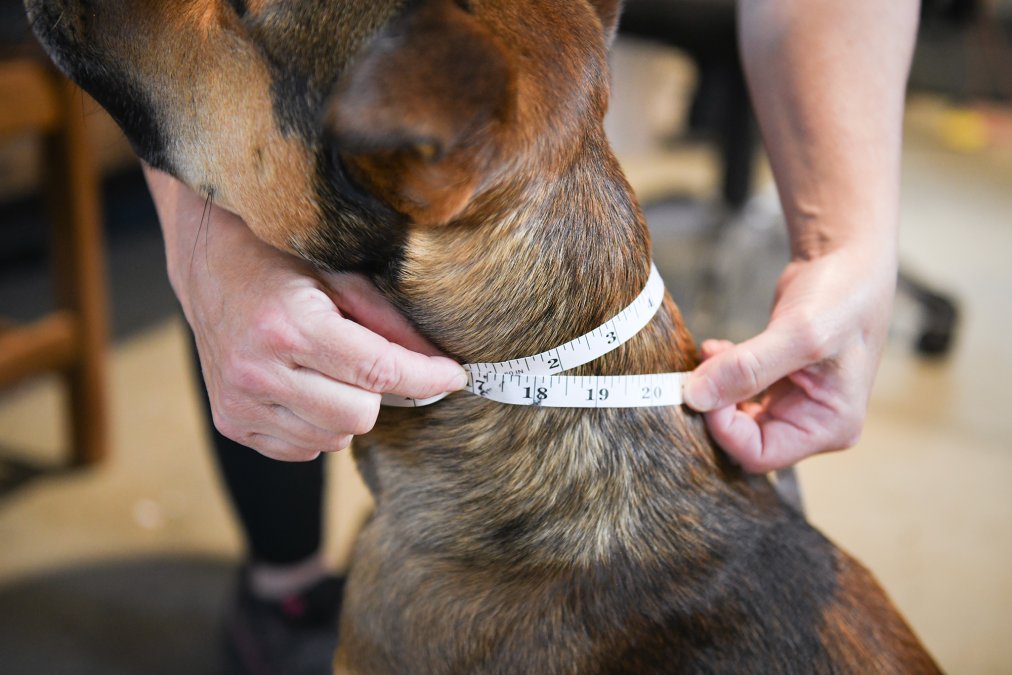
How to Measure Dog Neck for Collar: Sizing Guide
Follow these steps:
- Stand your dog on a level floor and keep them calm
- Place the tape around the upper neck, just below the ears
- Slide the tape until it sits snug, not tight
- Read the measurement where the tape meets itself
- Repeat twice and average the numbers
- Add roughly two fingers of room for comfort
Measure the upper neck, not the base where the shoulders start, collars sit high.
What You'll Need
- A soft cloth measuring tape, or a piece of string plus a ruler
- A helper to hold a wriggly dog steady
- Treats to keep your dog relaxed
If you only have a rigid tape measure, run a piece of string around the neck first, then lay the string flat against the ruler. For a full walkthrough, the RSPCA's advice on pet care and equipment is a useful reference.
How Tight Should a Dog Collar Be?
A correctly fitted collar lets you slide two fingers flat between collar and neck. Tighter presses on the throat; looser lets your dog back out. The part most guides skip is what to do when the two-finger test passes but something still feels wrong.
Run this quick check after every adjustment:
- Slide two fingers under the collar. They should pass with light resistance
- Pull gently upward. The collar should not slide over the ears
- Watch your dog walk, turn, and shake. The collar should stay in place
A snug fit is not a tight fit, you want secure, not compressed. Dogs with sensitive skin or short coats need extra attention, because friction shows up fast.
Troubleshooting a Fit That Fails the Check
The two-finger test is a starting point, not a diagnosis. Use the symptoms below to work out what is wrong before adjusting.
What you see |
What it usually means |
What to do |
|---|---|---|
Redness, thinning coat, or a bald patch behind the ears |
Collar sits too high and rubs on the ear base |
Lower it to the upper neck, below the ears but above the shoulders, and recheck |
Dog coughs, wheezes, or pulls back when the lead tightens |
Collar is too tight or sitting on the windpipe |
Loosen by one hole and switch to a flat collar rather than a narrow one |
Collar rotates so the buckle sits under the chin |
Too loose, or the collar is heavier than the neck can hold steady |
Tighten by one hole; if it still rotates, the collar is too wide or too heavy for the dog |
Dog backs out of the collar when startled |
Too loose, or the neck is narrower than the head |
Tighten, and consider a martingale-style collar that closes under tension |
Collar leaves a groove in the coat but no redness |
Slightly too tight, or the coat is being compressed |
Loosen by one hole and brush the coat out after walks |
Collar slides down onto the shoulders during walks |
Too loose, or the dog has a narrow neck and sloping shoulders |
Tighten by one hole and check the collar is not sitting below the shoulder line |
Work through one change at a time, adjusting size and position together makes it impossible to tell which fix worked.
Position Matters as Much as Tightness
A collar that measures correctly can still sit badly. It should rest on the upper neck, just below the ears and above the shoulder. If it drifts to the base of the neck, the two-finger test reads as loose even when the size is right, because the neck is wider there.
Coat type changes the reading too: a dog in full winter coat can measure an inch larger than in summer. Measure in the coat the dog will actually wear, and remeasure at seasonal changeovers.
Safety Checks and When to Remeasure
Fit is not a one-time job. Collars stretch, dogs gain and lose weight, and coats change. Build these checks into your routine:
River, 3/4" wide, size 9"-12" →
- Weekly: run the two-finger test and check for rubbing behind the ears and under the chin
- Monthly: inspect stitching, holes, and the buckle for wear, stretching, or cracking
- After grooming: remeasure, because a trimmed coat changes the reading
Retire any collar showing cracks, fraying, or stretched holes, a collar that fails under load is a safety risk.
Leather Dog Collar Sizing: What Makes It Different
Leather sizing runs differently from nylon. Leather has fixed holes, so the fit range is narrower than a webbing collar with a sliding buckle: a nylon collar might cover four inches, while a leather collar with holes one inch apart typically gives two to three inches of usable adjustment. That matters most for a dog sitting between sizes.
Key differences to know:
- Leather stretches slightly with wear, so a snug new collar settles in
- Holes are set at fixed intervals, usually one inch apart
- Wide collars need a closer fit, because a loose wide collar twists
- Thick leather adds bulk, which changes how the collar sits
How Sizing Ranges Differ Across Collar Types
Not every collar on a 20lb dog is sized the same way, and the type you choose changes the number you need.
Collar type |
How it is sized |
What to check for a 20lb dog |
|---|---|---|
Flat everyday collar |
By neck measurement, often with a stated range |
Match your measured neck to the middle of the range, not the edge |
Martingale or limited-slip |
By neck measurement at the tightest point |
Must not tighten past the neck measurement; check the closed circumference, not the open one |
Harness |
By chest girth, not neck |
A 20lb dog usually needs a small or small-medium harness measured around the widest part of the ribcage |
Training or slip collar |
By neck measurement plus a few inches for slip |
Only use under guidance; sizing is not the same as a flat collar |
Head collar |
By muzzle and neck measurement |
Sized separately from a standard collar and not a substitute for one |
Owners often buy a harness in the same size as their dog's collar. That rarely works, because harnesses are sized on chest girth, measure the chest separately.
Reading an Adjustable Range Against Your Measurement
When a maker lists a range such as 11 to 14 inches, that is the span the collar covers, not a target.
Aim for the middle. If you are asking what size collar for a 20lb dog measuring around 12 to 13 inches, a collar rated 11 to 14 inches gives adjustment in both directions.
This is why made-to-order leather works so well.
For comparison, our The Chili | Custom Dog Collar is a 1.25" wide padded leather collar built for comfort on smaller frames, while our Mini De Vil, 1.25" wide uses Black Latigo leather with a padded lining to prevent chafing, plus a tapered buckle that cuts bulk and weight.


Choosing Between Sizes and Avoiding Common Mistakes
Between sizes? Go larger on leather and adjust from there. Here are the most common mistakes.
Mistake |
Why It Happens |
The Fix |
|---|---|---|
Ordering by weight only |
Chart feels quicker than measuring |
Measure the neck first |
Measuring the neck base |
Collar sits higher than owners think |
Measure just below the ears |
Leaving no growth room |
Puppy measured once |
Remeasure every few weeks |
Ignoring coat thickness |
Winter coat adds bulk |
Measure in full coat |
Copying another brand's size |
Charts differ between makers |
Use the maker's own chart |
Three points deserve emphasis. Never assume a size carries across brands, a "medium" from one maker can match a "small" from another.
Measure the neck, add two fingers of room, and match that number to the maker's chart. Weight only narrows the options; the tape decides.
For dogs in serious training or canine sports, sizing matters even more: a loose collar shifts under load, a tight one restricts breathing. Our River, 3/4" wide, size 9"-12" is built for that level of work, crafted on English Bridle leather with black hardware and crystal detailing.

River, 3/4" wide, size 9"-12"
Make safety checks routine: a weekly finger check, a look for worn stitching or stretched holes, and retirement for any collar showing cracks or fraying.
Frequently Asked Questions
What size collar does a 20lb dog need?
A 20lb dog usually fits a small collar with a neck measurement around 10 to 14 inches (25 to 36 cm), though this varies with breed. A lean Whippet and a stocky Frenchie at the same weight can differ by several centimetres. Always measure the neck circumference directly rather than relying on weight alone, then match that measurement to the brand's own size chart.
How do I measure my dog's neck for a collar?
Use a soft measuring tape around the upper neck, just below the ears where the collar normally sits. Keep the tape snug but not tight, and record the measurement in centimetres. If you don't have a tape measure, use a piece of string and lay it against a ruler. Measure twice to confirm, and add roughly 2 cm (about two fingers) for comfort and adjustment room.
Can I choose a dog collar size based on weight alone?
Weight alone is not reliable. A 20lb dog could have a neck anywhere from 9 to 15 inches depending on breed, body shape, and coat thickness. Weight-based charts are useful as a starting estimate, but the neck measurement is what determines the actual size. For leather collars especially, getting the measurement right prevents rubbing and premature wear.
How can I tell if my dog's collar is too tight or too loose?
Use the two-finger fit test: slide two fingers between the collar and your dog's neck. If they pass easily, the fit is comfortable. If the collar feels tight against your fingers, it's too tight, and you should size up or loosen it. If you can fit more than three fingers or the collar slides over the head, it's too loose and could slip off during walks or training.
Getting the size right is the difference between a collar your dog forgets they are wearing and one that rubs, twists, or slips. Fusion By Design Collars handcrafts every piece to order in Canada using full grain English Bridle leather and genuine Swarovski crystals, with free worldwide shipping and a right fit, right style guarantee. Measure your dog's neck, send us the number, and choose your design with confidence.