


Table of Contents
- Why Custom Leather Dog Collars with Crystals Are Worth the Investment
- How to Measure Your Dog's Neck for a Collar
- The Benefits of Full Grain Leather Dog Collars
- Crystal Styles and Embellishments: What to Look For
- Swarovski Crystal Dog Collar Care and Leather Cleaning
- Matching Leashes and Accessories for Custom Leather Dog Collars
- Conclusion
- Frequently Asked Questions
Last Updated: October 6, 2026
Why Custom Leather Dog Collars with Crystals Are Worth the Investment
A well-made collar is the one piece of gear your dog wears every single day, so it pays to get it right. Custom leather dog collars with crystals combine full grain leather, hand-set Swarovski™ crystals and made-to-order sizing into a single accessory that works as hard as it looks.
The case for going custom comes down to three things: fit, materials and longevity.
- Fit: A made-to-order collar sits exactly where it should, which matters most for dogs with sensitive necks or heavy coats.
- Materials: Full grain English Bridle leather is the strongest part of the hide, and it softens with wear instead of cracking.
- Longevity: Properly cared for, a quality leather collar can outlast several mass-produced replacements.
Cheaper collars exist. They also fray, stretch and shed their stones within months. This guide explains how to measure your dog, what to look for in leather and crystals, and how to keep the finished piece looking new.
How to Measure Your Dog's Neck for a Collar
To measure your dog's neck for a collar, wrap a soft tape measure snugly around the middle of the neck, then add two fingers of slack.
Three measurement mistakes cause most poor fits:
- Measuring over a thick coat. Fluffy breeds can measure two sizes larger than their collar needs to be. Part the fur and measure against the skin.
- Measuring too low. The tape should sit where the collar naturally rests, just behind the ears and below the jaw.
- Forgetting the growth factor. Puppies and young dogs need a re-measure every few weeks until they stop growing.
If you are ordering a custom piece and cannot measure your dog yourself, send us the breed, age and current collar size. Our right fit, right style guarantee covers sizing adjustments on made-to-order pieces.
Getting the Fit Right for Small, Medium and Large Breeds
Small breeds need lighter hardware so the collar does not outweigh the dog. Medium breeds sit in the sweet spot for most standard widths. Large and giant breeds need wider straps and strong cast, not welded, buckles to spread load across the neck during training.
Breed Size |
Typical Neck Range |
Recommended Width |
Hardware |
|---|---|---|---|
Small (XXS-S) |
9-13 in |
3/4 inch or 1.25 inch |
3/4 inch Buckle |
Medium (M-L) |
14-18 in |
1.5 inch |
1 inch buckle |
Large (L-XL) |
19-25 in |
2 inches |
1 inch buckle |
The Benefits of Full Grain Leather Dog Collars
Full grain leather is the outermost layer of the hide, and it keeps the tight fibre structure that gives the leather its strength. Cheaper collars use split leather or bonded leather, which is glued from scraps and separates under load. Full grain English Bridle leather, the type we use, is vegetable-tanned for training and competition use, so it holds its shape through daily walks, wet weather and repeated pulling.
The practical benefits show up over time:
- It softens rather than cracks. A full grain collar breaks in like a good pair of boots.
- It resists odour. Leather breathes, so it does not trap moisture the way nylon does.
- It ages well. Scratches and patina become character rather than damage.
The one drawback is weight and cost. Full grain leather is heavier than webbing and carries a higher price.
Crystal Styles and Embellishments: What to Look For
Crystal quality and attachment method matter more than the number of stones. Genuine Swarovski™ crystals are cut with precision facets that reflect light evenly, while glass and acrylic rhinestones look flat in daylight. How the crystals are fixed to the leather decides whether they stay put through mud, rain and a dog rolling on the carpet.
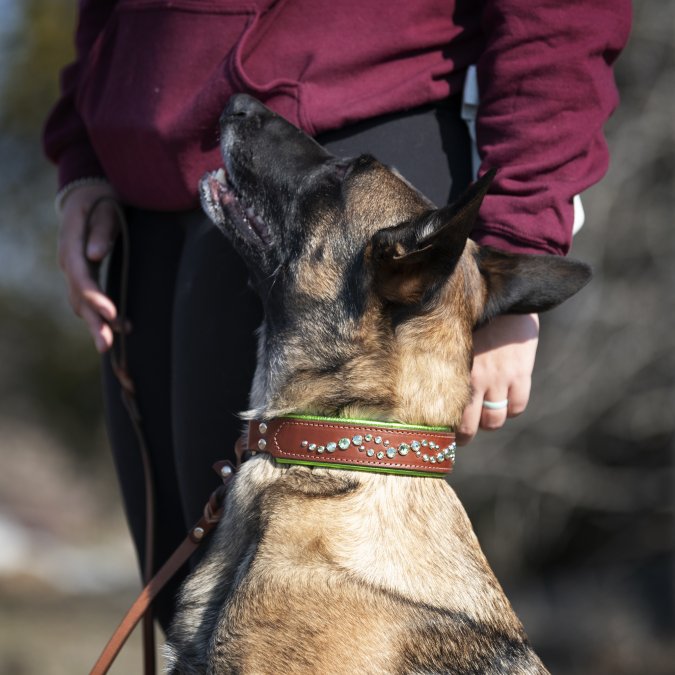
Best Leather Dog Collars for Training: 2026 Guide
Securing the perfect fit for these embellished pieces requires precision, as the process of measuring your dog ensures that the crystal alignment remains centered and comfortable during daily wear.
Crystal layouts you can choose
- Single row: One line of clear or coloured crystals down the centre. Understated, easy to clean and the least likely to catch on brush.
- Multiple rows of crystals: A wider band of stones for maximum sparkle, popular for competition and show dogs.
- Crystal studded edges: Stones set along the collar's border, which frames the leather rather than covering it.
How crystals are actually attached (and why it matters)
There are three common methods, and they age very differently:
- Recessed channel setting. A shallow groove is cut into the leather, the crystal is seated inside, and the surrounding leather holds it. The stone sits flush or slightly below the surface, so it resists snagging. This is commonly seen in horse tack such as crystal studded bridle brow bands.
- Prong or rim setting. A small metal cup grips the crystal and is fixed through the leather. Secure and replaceable, but the metal edge can catch on long coats if the setting is not smoothed. Properly setting a prong or rim setting requires skill and experience from the maker.
- Surface gluing. The crystal is adhered directly to finished leather. Cheapest and fastest to produce, and the first to fail, adhesive softens with body heat, moisture and flexing, and stones drop off one by one.
Ask any maker which method they use before you buy. A maker who hand-sets stones will tell you so without hesitation.
How long crystals last, and when to inspect them
A well-set crystal on a quality leather collar can hold for years of normal wear. The variables that shorten that life are predictable:
The Wave | Our Best-Selling Custom Leather & Crystal Dog Collar →
- Friction points. Where the collar rubs against a harness, seatbelt or crate bar, check the stones monthly.
- Swimming and bathing. Chlorine, salt and shampoo residue dull facets and weaken adhesive. Rinse and dry the collar after any soak.
- Extreme cold. Leather stiffens in freezing weather, and a stiff strap flexes less forgivingly around set stones. Inspect after winter walks.
A simple routine: once a month, run a fingertip along the crystal row. Any stone that rocks, sits proud of its neighbours or has a visible gap around it should be noted. Most makers will re-set a loose stone rather than replace the whole collar, so it is worth asking about repair terms at the point of order.
Swarovski Crystal Dog Collar Care and Leather Cleaning
Swarovski crystal dog collar care comes down to two routines: clean the leather without soaking it, and clean the crystals without scratching them. Wipe the leather with a damp cloth and mild soap, then let it air dry away from direct heat.
Follow these rules to protect both materials:
- Never submerge the collar. Soaking breaks down the leather's fibres and loosens the crystal settings.
- Avoid alcohol and harsh solvents. They dull crystal facets and strip the leather's finish.
- Condition the leather every two to three months. A small amount of leather balm keeps the strap supple.
Store the collar flat or hanging when it is not in use. A collar left crumpled in a bag can crease the leather and press the crystals against hard surfaces.
Matching Leashes and Accessories for Custom Leather Dog Collars
A matching set turns a single collar into a coordinated kit. Because every piece is made to order, you can carry the same leather, crystal style and hardware finish across a collar and leather leash. The result looks deliberate rather than assembled from whatever was in stock.
Customization choices compared side by side
Before you commit to a set, it helps to see how each decision affects look, comfort and wear. The table below compares the main options.
Choice |
Options |
Best for |
Trade-off |
|---|---|---|---|
Leather type |
Full grain English Bridle; full grain harness leather |
Daily wear, training, competition |
Heavier and pricier than split or bonded leather |
Strap width |
3/4 in, 1.5 in, 2 in. |
Small, medium, large breeds respectively |
Wider spreads load but adds weight |
Crystal colour |
Clear, champagne, jet black, rose, sapphire, custom mixes |
Matching a coat, a show theme or a leash |
Pale stones show dirt sooner than dark ones |
Crystal layout |
Single row, multiple rows, studded edges |
Understated daily wear through to show sparkle |
More stones mean more inspection points |
Hardware finish |
Brass, nickel, matte black |
Coordinating with existing tags or leads |
Plated finishes can wear at high-friction points |
Personalization |
Stamped name, name plate, phone number |
Identification and gifting |
Adds a small amount of weight to the strap |
Building a set in the right order
- Leather colour. Tan, black and deep brown are popular options. Pick the colour you want to live with daily, not the one that photographs best.
- Crystal style. Match the row count and stone colour across pieces, or use a plain leash so the collar stands out.
- Hardware finish. Keep the buckle, D-ring and leash clip in the same metal tone. Mixed metals read as accidental rather than designed.
- Personalization. Add a name plate or stamped name detail to the collar for identification, and leave the leash plain so the collar remains the focal point.
What to match, and what to deliberately vary
Not every piece needs to be identical. A common pattern among returning customers is to match leather and hardware across the set, then vary the crystal treatment: a four-row collar for shows, a single-row collar for everyday walks, and a plain leash that works with both.
One recent customer put it simply: "The craftsmanship is impeccable, I love the matching set of collars."
For a first custom order, The Wave is our best-selling design and the natural starting point. It pairs full grain leather with hand-set crystals and comes in a range of colour and hardware options, so you can match it to a leash later.

Conclusion
Choosing between a mass-produced collar and a bespoke one is really a question of how long you want the piece to last. Full grain leather, properly set crystals and an accurate neck measurement are what separate a collar that survives a season from one that survives years of training, travel and daily wear. If you are ready to order a piece built to your dog's exact measurements, browse our designs and choose your design.
Frequently Asked Questions
How do I measure my dog for a custom leather collar?
Use a soft tape measure and wrap it around the middle of your dog's neck, keeping two fingers under the tape for comfort. Record the measurement in inches. If your dog has a thick coat, add 1/2 inch. Compare the result to the size chart provided by the maker, and order to the nearest size. A custom made collar built to these numbers will sit snugly without rubbing or chafing.
How do you clean a leather dog collar with crystals?
Wipe the leather with a damp cloth and mild soap, then dry immediately with a soft towel. For the crystals, use a clean, dry microfibre cloth and gentle pressure. Avoid soaking the collar or using alcohol-based cleaners. Recondition the leather every few months with a leather balm to stop it drying out. This routine keeps the crystals bright and the leather supple for years of everyday use.
Are Swarovski™ crystals durable enough for active dogs?
Yes, when they are set correctly. Genuine Swarovski™ crystals are hard and scratch-resistant, and a quality jewelled collar attaches each stone with secure prong or channel settings rather than glue alone. For dogs in training or canine sports, choose a design where the crystals are hand-set rather than glued onto the leather so they are less likely to catch on branches or fencing.
What is the most durable leather for custom dog collars?
Full grain English Bridle leather is the strongest choice. It keeps the hide's natural fibres intact, so it resists stretching, cracking and water damage far better than split or bonded leather. Look for a maker who handcrafts to order, uses solid brass or stainless steel hardware, and stitches with heavy-duty thread. That combination is what makes a custom dog collar survive daily walks, training and travel.