


Table of Contents
- How Long Do Custom Leather Collars Last? Realistic Expectations
- The Factors That Decide Your Collar's Lifespan
- How to Care for a Leather Dog Collar Day to Day
- How to Clean a Leather Dog Collar Without Damaging It
- Leather Dog Collar Water Damage: What to Do and How to Prevent It
- Signs a Dog Collar Needs Replacing: A Practical Inspection Checklist
- Conclusion: Getting Years of Use From Your Custom Leather Collar
- Frequently Asked Questions
Last Updated: October 9, 2026
How Long Do Custom Leather Collars Last? Realistic Expectations
A well-made custom leather collar usually lasts for years of daily wear.
At Fusion By Design Collars, we have sold over 6,000 collars since 2016, and the pattern is consistent: stitching, hardware or fit usually gives out before the hide does.
Below, we break down what decides a collar's lifespan, how to care for a leather dog collar, and when it needs replacing.
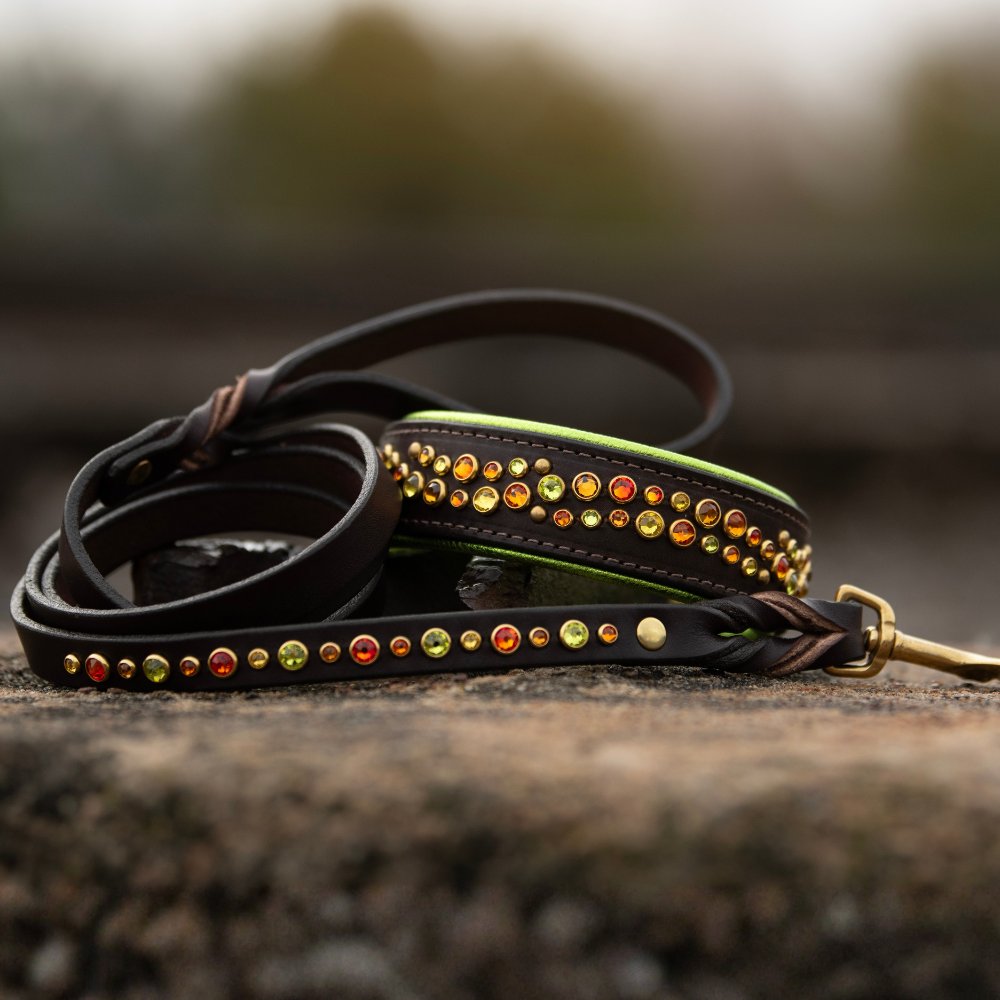
The Starlight | Maximum Sparkle 1.5” Wide Custom Leather & Crystal Dog Collar
The Factors That Decide Your Collar's Lifespan
Four things decide how long a leather collar lasts: leather quality, hide thickness, stitching and hardware, and how hard the dog works in it. Get all four right and you are looking at years; get two wrong and you are replacing it inside a season.
Leather Thickness, Stitching and Hardware Quality
Full-grain leather is the strongest part of the hide and keeps the tight fibre structure lower grades sand away, so it resists cracking and stretching far better than corrected-grain or bonded leather. Makers who build for working dogs often specify full-grain vegetable-tanned hide, English bridle or a comparable tannage, because the tannins keep protecting the fibres as it ages.
Thickness matters too.
Then there is the stitching. Reinforced stitching is where a collar earns its keep. Look for heavy bonded nylon or polyester thread, saddle-stitched by hand or locked with a backstitch at both ends so a broken stitch cannot unravel the run.
Edge finishing is the quiet indicator.
Hardware finishes the job:
- Solid brass or nickel plated brass buckles resist rust and pitting
- Cast D-rings hold their shape under a leash load, unlike welded D-rings which may snap under load.
- Rivets should sit flush and tight, never proud of the leather.
- Buckle tongues and prongs should be thick enough not to bend when the collar is tightened
Repairability is the last piece.
How Activity and Environment Change Everything
Two dogs, same collar, same age. One sleeps on a sofa and walks on pavement; the other trains in wet fields, swims in lakes and rolls in sand.
The enemies are predictable:
- Moisture breaks down the oils that keep leather supple
- Salt and mud dry the hide and draw out those oils
- UV light fades dye and weakens fibres over long summers
- Abrasion from rocks, fences and heavy brush scuffs the surface
Heat matters too: a collar left on a sunny dashboard or dried next to a radiator stiffens and cracks within weeks.
Think in tiers. A companion dog on lead walks and indoor living sits at the top of the range; a dog that hikes, swims or works in wet grass most days sits in the middle; a dog that lives outdoors, swims daily or trains in salt water sits at the bottom.
Custom Construction Details That Change the Maths
When you commission a collar, your design choices set the ceiling on how long it lasts.
- Strap thickness, ask for the weight figure, not a vague "heavy duty". The ideal is between 8-11oz.
- Edge finish, burnished and painted or dyed beats raw every time
- Attachment style, Stitched or Riveted D-ring plates outlast D-ring-through-loop designs
- Hardware material, solid brass or or nickel plated brass, not plated zinc
A maker who answers those four questions without hesitating is likely to reach the top of the range.
How to Care for a Leather Dog Collar Day to Day
Daily care takes about thirty seconds and adds years to the collar. Wipe it with a dry cloth after wet or muddy walks, and let it air dry away from direct heat. That single habit prevents most of the damage we see.
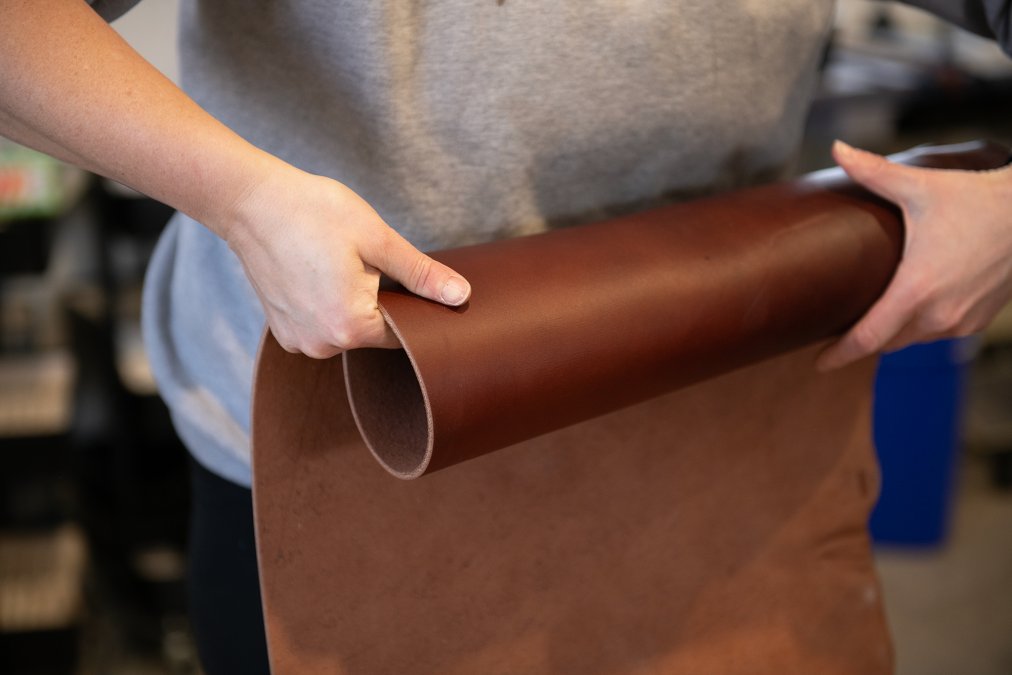
Regular maintenance prevents the material from drying out or cracking, establishing a consistent routine that makes it easier to care for leather goods while preserving the integrity of your pet's accessories.
Here is a recommended routine:
- Wipe off mud and grit after every messy walk
- Air dry at room temperature, never on a radiator
- Condition every two to three months
- Check the buckle holes for stretching once a month
- Rotate between two collars if your dog wears one daily
A second collar is not a luxury: alternating gives each one time to dry fully between wears.
How to Clean a Leather Dog Collar Without Damaging It
Cleaning a leather collar takes about ten minutes, and the method matters more than the products.
Match the Method to the Leather and Finish
Before you touch the collar, work out what you are cleaning:
The Starlight | Maximum Sparkle 1.5" Wide Custom Leather & Crystal Dog Collar →
- Vegetable-tanned bridle leather (the traditional tanning used on most quality dog collars) is dense, firm and takes conditioner well. It tolerates a barely damp cloth and mild saddle soap, and it benefits from regular conditioning because the tannins alone will not keep it supple forever.
- Oil-tanned or hot-stuffed leather arrives already saturated with oils and waxes. It needs very little added conditioner and can turn greasy or dark if over-treated. Clean with a dry cloth first and only dampen it if there is actual grime.
- Chrome-tanned leather is softer and more colour-fast but less resistant to repeated wetting. Keep water to a minimum and avoid heavy soaps that can lift the finish.
- Finished or coated leather (patent, painted edges, sealed surfaces) should never see saddle soap or oil. Wipe with a damp cloth only. Conditioners and soaps will sit on top, dull the finish and attract dirt.
The Cleaning Routine
Work through it like this:
- Brush off loose dirt with a dry cloth
- Wipe the surface with a barely damp cloth and a little mild saddle soap, skip the soap entirely on oil-tanned or coated leather
- Clean around the buckle, D-ring and rivets with a soft brush
- Wipe away all soap residue with a clean damp cloth
- Let it air dry fully, away from heat and sun
- Apply a thin layer of leather conditioner once dry, only if the leather type calls for it
- Buff off any excess with a dry cloth
A thin coat worked in with your fingers is enough.
Products to Avoid
Some household staples do more harm than good on leather:
- Washing-up liquid and detergents strip the natural oils and leave the fibres dry
- Vinegar, bleach and alcohol break down the tannage and can lift dye
- Pet wipes designed for fur often contain moisturisers that leave a film on leather
- Waxes and heavy greases clog the pores and stop the leather breathing
- A washing machine or dishwasher, never, on any leather type
A dedicated leather cleaner and a pH-neutral saddle soap cover almost every case.
Leather Dog Collar Water Damage: What to Do and How to Prevent It
Leather dog collar water damage shows up as stiffness, dark blotches, raised grain or a musty smell.
Here is what to do when the collar gets soaked:
- Blot the surface with a dry towel straight away
- Reshape the collar while it is still damp
- Air dry at room temperature, away from radiators and sun
- Condition once fully dry to replace lost oils
- Never force-dry with a hairdryer or oven
Prevention is simpler: a light application of quality leather conditioner creates a barrier that sheds water.
For dogs that swim or train in wet conditions regularly, a second collar to rotate is the practical answer.
Drying a wet leather collar on a radiator or in direct sun causes the fibres to shrink and crack.
Signs a Dog Collar Needs Replacing: A Practical Inspection Checklist
Replace a leather collar when the leather has cracked through, the stitching is fraying, the hardware is bent or rusted, or the buckle holes have stretched enough to slip. Any one of those is a safety issue, not a cosmetic one.
Run this check once a month. It takes two minutes.
What to Check |
Warning Sign |
Action |
|---|---|---|
Leather surface |
Deep cracks or splits |
Replace now |
Stitching |
Fraying or broken threads |
Repair or replace |
Buckle holes |
Stretched, torn or rounded |
Replace |
D-ring |
Bent, loose or rusted |
Replace |
Rivets |
Loose, missing or proud |
Repair or replace |
Fit |
Two fingers no longer fit under the collar |
Resize or replace |
Smell |
Persistent musty or sour odour |
Clean, then reassess |
Fit deserves its own mention: a stretched collar or a dog that has gained weight turns a comfortable collar into a chafing one. Check that two fingers, and no more, slide under the collar.
If your dog has a sensitive neck, fit is the whole point. That is why every collar we make is built to order around your dog's exact measurements, with padded linings on styles like The Starlight custom leather & crystal dog collar to spread pressure evenly.
Conclusion: Getting Years of Use From Your Custom Leather Collar
The honest answer to how long custom leather collars last is that the collar is rarely the limiting factor. Care, fit and workload decide the outcome.
That is the case for buying once and buying properly. Our collars are handcrafted in Canada from full grain English Bridle leather, made to order for your dog's measurements, and backed by our right fit, right style guarantee. Add free worldwide shipping and the maths gets simple.
Choose your design and get a collar built to see your dog through years of training, travel and everyday adventures.
Frequently Asked Questions
How long should a leather dog collar last?
A well-made custom leather collar typically lasts for years with regular care. Daily wear, climate, and how often your dog swims or gets muddy all shift that window.
What affects the lifespan of a custom leather collar?
Leather quality, thickness, stitching, hardware, and how you care for it all matter. Full-grain leather with reinforced stitching and solid brass or nickel plated brass hardware holds up far better than thinner leather with glued seams. Daily exposure to water, mud, and sun accelerates wear, while regular conditioning slows it down.
How can I make a leather dog collar last longer?
Wipe it down after muddy walks, let it air dry away from direct heat, and condition it every few months with a leather-specific product.
Can a leather dog collar get wet?
A brief splash of rain is fine, but repeated soaking causes leather to stiffen, crack, and lose shape over time.