


Table of Contents
- Why Artisan Leather Collars Outlast Off-the-Shelf Options
- Benefit 1: A Fit That Stays Comfortable Through Every Training Session
- Benefit 2: Leather Dog Collar Sizing That Actually Fits Your Dog
- Benefit 3: Custom Leather Dog Collars Built to Your Specifications
- Benefit 4: Crystal Detailing That Survives Real Life
- Benefit 5: Leather Dog Collar Care That Keeps It Looking New for Years
- What to Look For When Choosing an Artisan Leather Collar
- Frequently Asked Questions
Last Updated: October 7, 2026
Why Artisan Leather Collars Outlast Off-the-Shelf Options
Walk down any pet shop aisle and you will find a wall of collars that look sturdy enough.
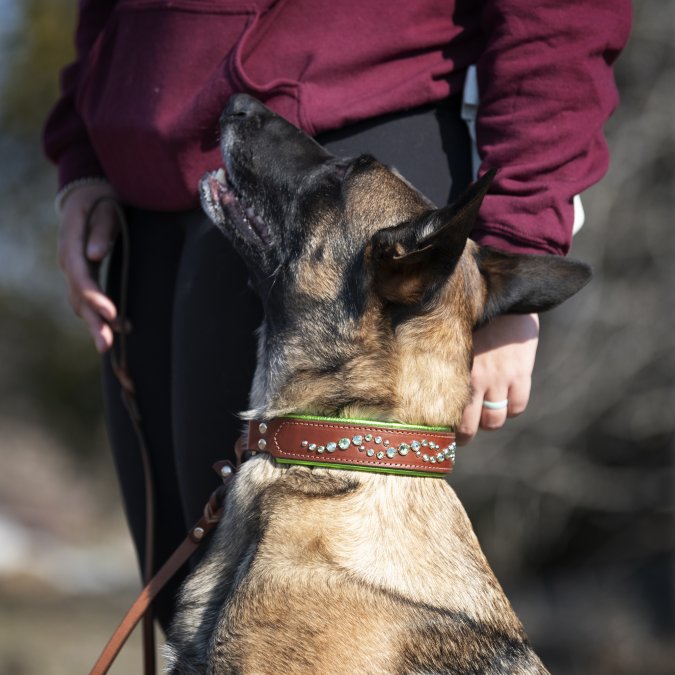
Artisan leather collars are handcrafted from full-grain hides, assembled by a maker rather than a production line, and finished to a specific dog's measurements.
We have been making made-to-order leather collars in Canada since 2016, with over 6,000 sold, and our workshop draws on more than 30 years of canine training and competing experience.
Full-Grain Leather vs Corrected Grain: What Actually Matters
Full-grain leather is the top layer of the hide, with the natural grain intact and no surface sanding or coating. Corrected grain has been buffed and refinished to hide scars and inconsistencies, usually with a polymer topcoat.
That topcoat looks uniform on day one, then cracks and peels where the collar flexes most, typically around the buckle and D-ring. Once the finish fails, the leather underneath dries out and weakens.
Benefit 1: A Fit That Stays Comfortable Through Every Training Session
A collar that rubs is a collar your dog will fight. The usual cause is a stiff band pressing against the trachea and the base of the neck during leash pressure.
Padded construction solves most of this. Our wide collars, such as The Breckenridge, use a 2" padded band that spreads pressure across a larger surface area instead of concentrating it on one narrow strip.

Benefit 2: Leather Dog Collar Sizing That Actually Fits Your Dog
Leather dog collar sizing starts with one number: the neck measurement, taken snugly with a soft tape, not the length of the old collar. Most fit problems trace back to measuring a worn collar instead of the dog.
Width should follow neck size and breed. A 3/4" collar suits a small breed or a growing puppy, 1.25" is the everyday middle ground for medium breeds, and 2" is built for large breeds, working dogs, and anyone who wants pressure spread across a broader area.
How to Measure Your Dog's Neck at Home
- Stand or sit your dog comfortably, head up, not straining forward.
- Wrap a soft measuring tape around the middle of the neck, where the collar naturally sits.
- Keep the tape snug against the coat but not tight enough to indent the skin.
- Note the measurement in centimetres and add roughly 2 cm of breathing room.
- Measure twice, at a different time of day, and use the larger number.
- If your dog sits between two sizes, size up.
If the measurement lands between sizes, tell the maker. Made-to-order sizing exists so you do not have to settle for the nearest stock size.
Choosing a Width by Neck Size and Build
Neck measurement alone does not decide width. Coat length, neck length, and how the dog carries its head all change how a band sits. The table below is the starting point we use in the workshop.
|
Neck measurement |
Typical width |
Why |
|---|---|---|
|
Under 11 inches |
3/4" |
Light enough for a small frame; a wider band overwhelms a short neck |
|
12-15 inches |
3/4" to 1.25" |
Puppies and small breeds; leaves room to grow into a 1.25" band |
|
15-19 inches |
1.25" to 1.75" |
Medium breeds; the everyday middle ground |
|
19-22 inches |
1.5” to 2" |
Larger medium and strong-necked breeds |
|
Over 22 inches |
1.75" to 2.25" |
Large and giant breeds; spreads leash pressure over more surface |
A short-coated dog with a long, slender neck often suits a wider collar than the table suggests, because there is less coat to cushion the edges.
Fit Examples
- A whippet with a 13 inch neck and a fine coat: 3/4" to 1.25” wide collar, measured snug, buckle just behind the ears when the head is up.
- A Labrador with a 19 inch neck: 1.5" band as the default, moving to 1.75" if the dog pulls hard on lead.
- A Rottweiler with a 22 inch neck: 2" padded collar, distributing pressure across the broadest area of the neck.
Checking the Fit After It Arrives
A new collar should sit high on the neck, behind the ears, not down on the shoulders, with room to slide two fingers flat under the collar. If you can fit a whole hand it is too loose; if the skin puckers it is too tight. Walk the dog, ask for a sit and a recall, and watch whether the collar rotates or the buckle drifts to the throat.
Benefit 3: Custom Leather Dog Collars Built to Your Specifications
Custom leather dog collars are made to a measurement and a design brief, not pulled from a shelf. The leather colour, padding colour, crystal colour and hardware finish are all decisions you make, and the collar arrives fitted to your dog.
Our made-to-order process works like this: you select the collar size, choose the width, pick your leather and crystal combination, and we build the collar to those specifications.
The design range is wide. The Mini De Vil pairs crystals with hex shaped spots crafted on English Bridle leather and padded with your choice of metallic or chap leather. Limited Edition Collars are a limited run of 12-15 collars in exclusive designs and colours with hand-set crystal patterns that will not be restocked.
|
Collar |
Width |
Leather |
Best For |
|---|---|---|---|
|
2" |
Full-grain, padded |
Large breeds, working dogs |
|
|
1.25" |
Full-grain, padded |
Medium breeds, everyday wear |
|
|
1.25" |
Black Latigo |
Medium breeds, statement colour |
|
|
3/4" |
English Bridle |
Small breeds, puppies |
|
|
1.5" |
English Bridle |
Martingale fit, training |
Benefit 4: Crystal Detailing That Survives Real Life
Crystals fall off cheap collars because they are glued onto a finished surface. Hand-setting works differently: each crystal is seated into the setting so it sits flush with the leather rather than on top of it.
We use genuine Swarovski™ crystals, hand-set into the collar. The attachment method determines whether the sparkle lasts a season or five years, and it is the biggest reason two visually identical collars can differ enormously in price.
How Crystals Are Attached, and Why It Matters
The crystal is seated into a specially designed pronged rimset and the seated into the leather. The rimset protects the edges of the stone. This is the method we use.
The Breckenridge | Wide Custom Dog Collar →
Hand-setting takes longer per crystal and cannot be rushed, which is why it is rare on mass-produced collars.
Where Crystals Sit Changes How Long They Last
Durability also depends on placement. A full row running the length of the collar takes more contact than a cluster near the buckle. The fastest-wearing areas are those that rub against the dog's coat, the lead clip, and anything the dog pushes through.
- High-wear zones: under the buckle, around the D-ring, and the section against the throat when the dog pulls.
- Low-wear zones: the upper side of the band, and the section behind the ears when the head is up.
For dogs that swim, roll or work in brush, keep crystal coverage low in the high-wear zones.
Inspecting and Caring for Set Crystals
A two-minute check every few months catches problems before a stone is lost:
- Run a fingertip along the crystal line. Any stone setting sitting proud of the leather has started to lift.
- Look at the leather around each setting for a dark ring or hairline crack, which signals moisture under the surface.
- Check the D-ring and buckle for movement, since a loose fitting shifts the band and puts sideways pressure on nearby settings.
- Wipe the collar with a damp cloth and dry it flat, away from direct heat.
If a stone comes loose, stop wearing the collar and have it reset rather than gluing it back yourself. Household adhesives cure hard and brittle and will not hold on a flexible collar.
Is a Crystal Collar Suitable for Everyday Wear?
Yes, with two caveats. Weight is the first: a fully crystal-set collar is heavier than a plain one, and on a small breed that extra weight can make the collar rotate.
Many owners who use crystal collars daily keep one for walks and training and one for shows and photos. That is not because the collar is fragile; it is because the dress collar stays clean and the working collar takes the mud.
Benefit 5: Leather Dog Collar Care That Keeps It Looking New for Years
Leather dog collar care comes down to three habits: keep it dry, clean it gently, and condition it before it looks dry. Leather is skin, and it fails the same way skin does when stripped of moisture.
- Wipe the collar with a damp cloth after muddy walks, then air dry it away from direct heat.
- Use a mild saddle soap for deeper cleaning, working it in with a soft cloth and wiping off the residue.
- Apply a leather conditioner two to four times a year, more often in dry climates or after repeated wetting.
A well-cared-for full-grain collar softens and darkens with age rather than cracking. That patina is the point.
What to Look For When Choosing an Artisan Leather Collar
Start with the leather description. If the listing does not say full-grain or name the tannage, assume corrected grain and expect the finish to fail at the flex points.
Then check the construction: reinforced stitching, properly set rivets or chicago screws at the buckle, and a padded lining if your dog has a sensitive neck or a short coat.
Finally, look at who is making it.
We built our range around those details, and every collar ships free worldwide.
Frequently Asked Questions
Are leather collars comfortable for dogs?
Full-grain leather softens with wear and moulds to the shape of your dog's neck, which reduces rubbing over time. Padded linings add cushioning for dogs with sensitive skin. The key is correct sizing: a collar that sits too loose can slide and chafe, while one that is too tight causes pressure points. Made-to-order artisan leather collars are crafted to your selected size, so the fit stays comfortable through training, walks and travel.
How do you choose the right size leather dog collar?
Measure your dog's neck at the widest point with a soft tape, then add roughly two fingers' width of slack. Artisan makers often ask for this measurement directly rather than relying on generic S, M or L labels. Leather dog collar sizing works best when you provide an exact neck measurement and note your dog's breed and build. Choose the collar size that has your dog's neck measurement sitting in the centre of the size range. A made-to-order collar is then cut to that figure, so there is no guesswork between sizes.
How should you care for a leather dog collar?
Wipe the leather with a damp cloth after muddy walks and let it air dry away from direct heat. Apply a leather conditioner every few months to keep full-grain leather supple and prevent cracking. Check stitching, hardware and crystal settings monthly for looseness. Remove the collar before swimming in chlorinated or salt water. With routine leather dog collar care, a quality collar can last for years of daily wear.
Are handmade leather dog collars durable?
Durability depends on the leather grade, stitching and hardware. Full-grain English Bridle leather is dense and resists stretching, while solid brass or nickel-plated brass hardware hold up to daily pulling. Handmade collars are assembled with these materials rather than bonded or corrected-grain leather, so they handle training sessions, hikes and travel far better than mass-produced alternatives.
Can a leather dog collar be personalised?
Yes. Custom leather dog collars can be personalised with your dog's name, chosen leather colour, crystal colour and hardware finish. Many artisan makers offer design-your-own options so you select the width, padding and crystal pattern. Personalisation also extends to matching leashes or martingale styles, giving you a coordinated set that reflects your dog's personality while keeping the fit specific to your dog.
Choosing a collar for a dog that trains, travels and works is a durability decision before it is a style one. Fusion By Design Collars handcrafts every piece to order in Canada from full-grain English Bridle leather, with genuine Swarovski crystals and a right fit, right style guarantee, plus free worldwide shipping. Choose your design and get a collar built to your dog's exact measurements.